Anthropic Pre-IPO Perp (io:ANTH): How It Actually Works
Researched and written by Concept211 from Entropy's own docs, its public API and on-chain data. Not sponsored, reviewed or approved by Entropy, Bursa Global or Hyperliquid. We earn a referral share if you sign up through our link. How we research
Table of Contents
- The price is a market cap, not a share price
- Contract specification, verified 2026-08-26
- Why you may not be able to open a position
- The mark price is Entropy's own order book
- Funding on io:ANTH is unusually small
- Fees: what you actually pay
- Settlement: the 2028 date and what it resolves to
- The Anthropic position and the Entropy position
- Access, geography and the risks worth pricing
- Where else Anthropic exposure trades
- If you are going to trade it
io:ANTH is a cash-settled perpetual future on Anthropic's implied private-market valuation, deployed by Entropy as a HIP-3 market on Hyperliquid. It went live on 2026-08-19 at 10:00 UTC. It is not a share, not a tokenized share, and not a claim on Anthropic. The single thing most new traders get wrong is the price itself, so start there.
Warning
EntropyGuides is an independent third-party site. We have no relationship with Entropy or with Anthropic. Links to Entropy in this article are referral links. Nothing here is legal, tax or investment advice. See our disclaimer.
The price is a market cap, not a share price
Every pre-IPO perpetual Entropy deploys is denominated in billions of dollars of implied company valuation. One dollar of contract price equals one billion dollars of market cap.
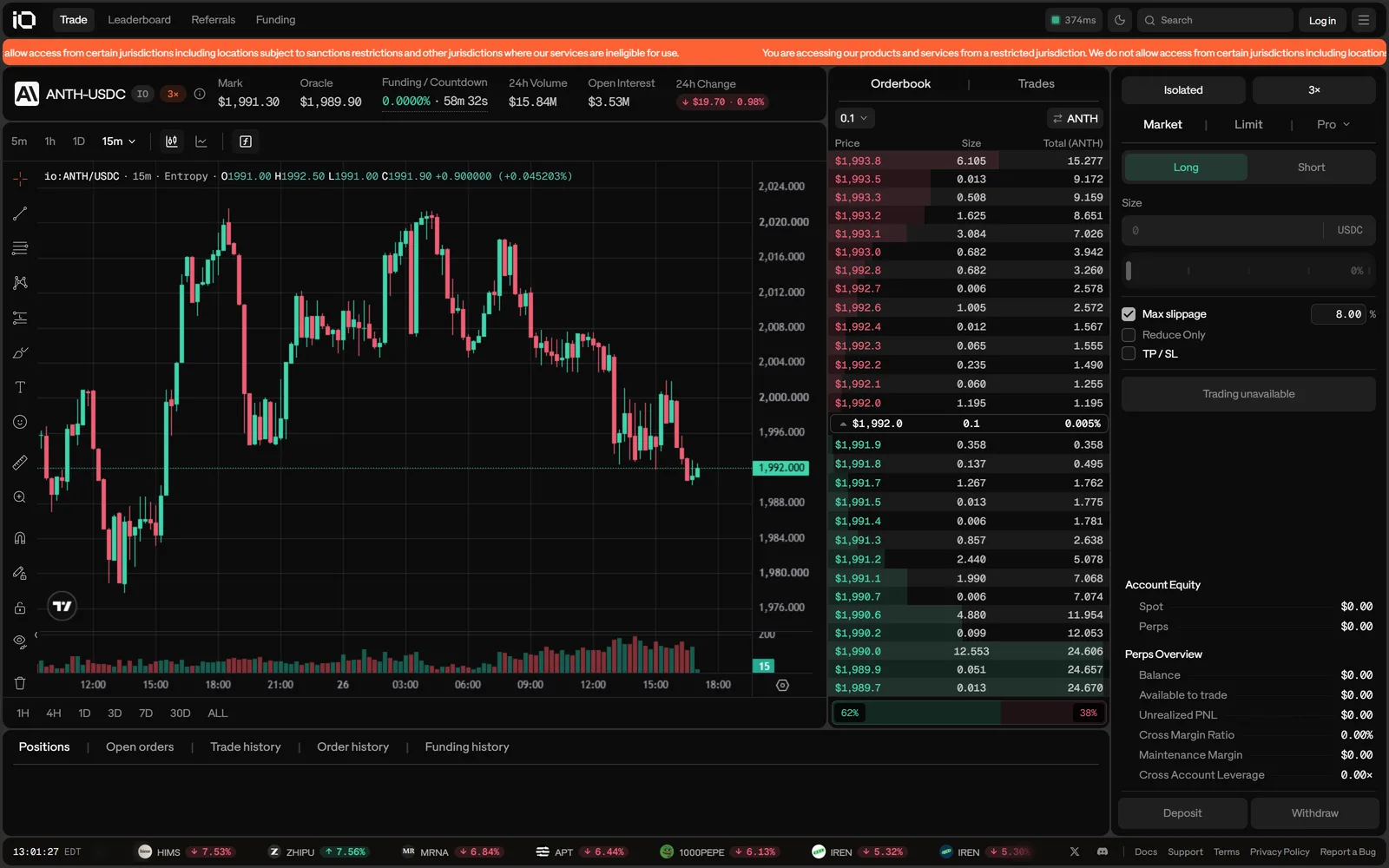
So when the io:ANTH mark reads 1995.2, as it did on 2026-08-26 around 14:00 UTC (pulled from api.hyperliquid.xyz/info with {"type":"metaAndAssetCtxs","dex":"io"}), the market is pricing Anthropic at roughly $2.00 trillion. It is not saying an Anthropic share costs $1,995. There is no share count anywhere in the contract specification and no per-share conversion.
This matters for position sizing as much as for reading the chart. A move from 1995 to 2095 is a 5% move in the contract, and it corresponds to $100 billion of implied valuation. At the 3x leverage ceiling, that same 5% move is 15% of your isolated margin.
| What you see | What it means |
|---|---|
| Mark 1995.2 | Roughly $2.00 trillion implied Anthropic valuation |
| Lower bound L = 300 | $300 billion implied valuation |
| Upper bound U = 4,200 | $4.2 trillion implied valuation |
| A 1-point move | $1 billion of implied valuation |
 Anthropic's own most recent primary-round valuation is not something this site publishes from memory, and you should not infer one from the io:ANTH mark either. The mark is what traders on one venue are willing to pay for a synthetic exposure, and as the next section explains, it is computed almost entirely from that venue's own order book.
Contract specification, verified 2026-08-26
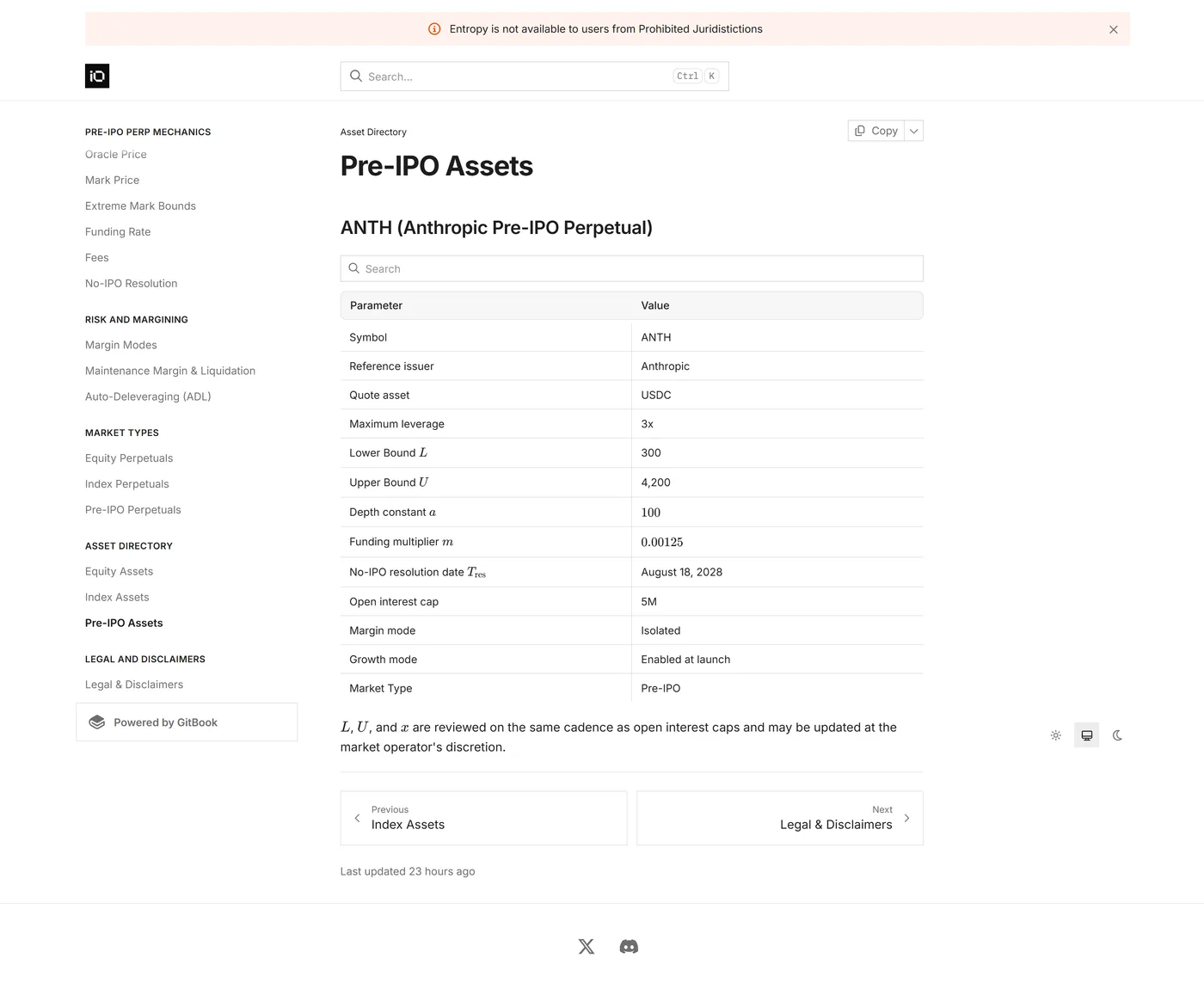
| Parameter | Value |
|---|---|
| Ticker | io:ANTH |
| Deployer | Entropy, HIP-3 deployer ticker io |
| Underlying | Anthropic, implied market capitalization |
| Quote and collateral | USDC |
| Max leverage | 3x |
| Margin mode | strictIsolated (per the API) |
| Extreme mark bounds | L = 300, U = 4,200 |
Depth constant a | 100 |
Funding multiplier m | 0.00125 |
| Open interest cap | $5,000,000, raised 2026-08-25 18:14 UTC |
| No-IPO resolution date | 2028-08-18 |
| Growth Mode | Enabled since 2026-08-19 14:12 UTC |
Two notes on that table. First, the 3x cap is specific to this market. Entropy's other live market, the SanDisk equity perp io:SNDK, runs at 10x. Pre-IPO markets carry the tighter ceiling.
Second, cross margin is not available here. Both of Entropy's live markets report marginMode: "strictIsolated" through the Hyperliquid API, which means each position carries its own margin and cannot draw on the rest of your balance. Entropy's documentation says the opposite, listing Strict Isolated as "Not enabled". The API and the live product win that disagreement. If you were planning to net io:ANTH against another position, you cannot.
Why you may not be able to open a position
 Entropy set the io:ANTH open interest cap at $5 million on 2026-08-25. As of 2026-08-26 around 14:00 UTC, open interest sat at roughly $3.33 million, or 66.6% of the cap, against $13.6 million of 24-hour notional.
That is a small cap for a market doing that much volume, and it is the failure most likely to hit you before you have traded a single contract. When the cap is reached, orders that would increase open interest are rejected. Reduce-only orders continue to work. There is no queue and no notification, so a rejected order looks like a generic failure in the UI.
Caps are operator-controlled and were already raised once. Re-check the live figure before you size anything: {"type":"metaAndAssetCtxs","dex":"io"} against api.hyperliquid.xyz/info returns openInterest and the cap for both io markets, no API key needed. Our cannot open a position guide walks through the other rejection causes.
The mark price is Entropy's own order book
This is the mechanic that deserves the most attention, and it is the one Entropy documents most plainly.
For pre-IPO markets, the mark is clip(I(t), L, U), where I(t) is a five-minute exponential moving average of the mid price on Entropy's own book, clipped to the extreme bounds of 300 and 4,200. It does not blend external sources directly.
Entropy's docs state that the mark drives "unrealized PnL, margin calculations, liquidation triggers, and stop/take-profit triggers." So on io:ANTH, the number that liquidates you is a smoothed average of the venue's own mid, bounded only at $300 billion and $4.2 trillion of implied valuation.
Entropy does publish a separate liquidity-weighted oracle roughly every three seconds, which blends the internal price with an external aggregate. Two things about it are worth stating precisely:
- The internal weight caps at 0.95, so the external aggregate retains at least 5%.
- Entropy's documentation says the scoring and aggregation procedure is "internal". The external sources are not enumerated and the weighting method is not published.
The oracle is not the pre-IPO mark. On io:ANTH, the oracle is a reference number and the mark is what settles your PnL.
There is one further wrinkle. Entropy's docs say of the extreme mark bounds that "the order book remains unrestricted... Trades may execute outside the bounds. Only the published mark and oracle are clipped." The bounds protect the published mark. They do not protect your fill. We unpack this and the rest of the category mechanics in pre-IPO perps explained.
Funding on io:ANTH is unusually small
Perpetual funding exists to tether a contract with no expiry to something. On io:ANTH there is nothing external to tether to on a continuous basis, and the funding multiplier reflects that: m = 0.00125, which Entropy's documentation describes as "roughly one-eighth of the Hyperliquid default."
For comparison, Entropy's equity perps use m = 0.5 during market hours and 0.125 outside them. The pre-IPO setting is 400 times smaller than the in-session equity one.
The practical effect is that carrying a directional io:ANTH position for weeks costs far less in funding than an equivalent crypto perp would. Funding is peer to peer, and Entropy states that "the exchange takes no fee on funding payments." The trade-off is that funding is the mechanism that normally drags a perp back toward an external reference, and its pull here is very weak, on the one market where that reference is least observable.
Fees: what you actually pay
 HIP-3 markets charge 2x the standard validator-operated perpetual rate, and the protocol fee is split evenly between Hyperliquid and the deployer. That would put the headline rate at 0.030% maker and 0.090% taker.
But Growth Mode is enabled on io:ANTH, and Entropy's docs state that when it is on, "all fees, rebates, and volume contribution scale by 0.1 (a 90% reduction)."
| Role | Base perp rate | HIP-3 rate (2x) | With Growth Mode, what you pay today |
|---|---|---|---|
| Maker | 0.015% | 0.030% | 0.0030% |
| Taker | 0.045% | 0.090% | 0.0090% |
Entropy's own documentation never states the effective rate its live markets run at. We cross-checked it independently: $66,194,725 of 24-hour io dex notional at 0.009% comes to $5,958, and  DefiLlama reported $5,982 of 24-hour fees for the same period. That is a ratio of 1.00.
Be clear about what this does and does not prove. Growth Mode is a standard HIP-3 lever, not an Entropy invention, and  trade.xyz runs it too. The honest version is that io:ANTH is cheap in absolute terms right now, at a measured all-in rate near 0.009%, and that the setting can be changed by the operator. Full breakdown in our Entropy fees guide.
One fee item is not in the documentation at all. Entropy's onboarding requires you to approve a builder fee before you can trade. The shipped code sets the charged rate to 0 and the builder address holds no accrued fees, so nothing is being taken today. The approval you sign authorizes a maxFeeRate of 1%. The word "builder" appears zero times in Entropy's docs, terms, privacy policy and risk disclosure. We report that as observable code behavior and make no claim about why it is configured that way.
Settlement: the 2028 date and what it resolves to
io:ANTH has a scheduled no-IPO resolution date of 2028-08-18, two years from listing.
If Anthropic goes public before then, the market converts on the IPO path. If it does not, the contract settles to the 30-day trailing time-weighted average of the mark price. The mark, as established above, is a five-minute EMA of Entropy's own book.
Read that loop carefully, because it is the central structural criticism of the whole product category. A no-IPO settlement does not converge to any external valuation of Anthropic. It converges to the average of what the last month of trading on one venue produced. Alea Research made this the core of its analysis of Entropy's pricing on 2026-08-25. Entropy's documentation also allows the market operator to issue an early resolution notice.
The Anthropic position and the Entropy position
These are two separate public statements and they are both worth reading in full before you trade this market.
Anthropic, in a support article published on 2026-05-12/13, stated that transfers of its stock through special purpose vehicles are "void under our transfer restrictions", and warned that third parties selling exposure through "direct sales, forward contracts, tokenized securities, or other mechanisms" are "likely either engaged in fraud or offering an investment that may have no value." The article is on Anthropic's support site, and CoinDesk covered the market reaction.
Entropy, on its own legal and disclaimers page, states that its contracts are "not equity, securities entitlements, ownership interests, IPO allocations, tokenized shares" and that holders receive "no voting rights, dividend rights, information rights, registration rights, allocation rights, delivery rights". The same page states that "the exchange has no affiliation with, endorsement from, or contractual relationship with any referenced issuer." Its terms of service add that any label the interface uses "is descriptive only and does not determine the legal or regulatory classification", and that the company "is not licensed by the Superintendencia del Mercado de Valores de Panamá (SMV)."
Those two positions are describing different objects. Anthropic is describing instruments that purport to convey exposure to its stock. Entropy is describing a cash-settled contract that claims to convey nothing at all. This site does not tell you whether that distinction holds up. We are not lawyers, that is a legal question, and the honest answer is to read both primary sources and take advice from a qualified professional in your jurisdiction.
For a regulator's framing of the adjacent question, SEC Commissioner Hester Peirce's July 2025 statement on tokenized securities is worth reading directly.
Access, geography and the risks worth pricing
 Collateral is USDC only, bridged from Arbitrum One. Entropy's terms of service name the United States, Canada, Panama and the United Kingdom as Restricted Jurisdictions. From a US IP address,
 entropy.io/api/geo/status returns {"restricted":true,"country":"US","mode":"trading","reason":"country"}. The restriction is scoped to trading rather than to the whole site, and it is not spoofable through query parameters or forged headers. Section 2.3 of the terms prohibits VPNs, proxies and Tor for circumvention. We describe what the terms say and what the endpoint returns, and stop there. See restricted countries for the full text.
Beyond the mark and the settlement path, a few things belong in your risk assessment.
There is no liquidator vault. Entropy's docs state that because HIP-3 markets do not have a liquidator vault backstop, auto-deleveraging is the immediate fallback after order-book liquidation, and that "ADL cannot be opted out of." A profitable io:ANTH position can be closed by the system without your input.
One key can halt the market. The io dex splits operator powers across four addresses, and a single one of them can call haltTrading, which under Hyperliquid's HIP-3 rules cancels all orders and settles positions to the current mark.
The venue is seven days old. No security incident, oracle failure or bad liquidation has been publicly reported on Entropy. With this little history, that is what you would expect either way, and it is not evidence of robustness. Our is Entropy safe page goes through the custody model, the absence of 2FA and the audit position.
Where else Anthropic exposure trades
io:ANTH is not the only place to take a view on Anthropic, and  Coinbase runs a CFTC-regulated Anthropic perpetual in the US, which makes any "only way to trade Anthropic" claim wrong on its face. TradFi secondary marketplaces sell actual share exposure to accredited investors at very different cost structures. We compare all of them, with fees and sources, in where to trade Anthropic pre-IPO.
 One warning about the guides currently ranking for this query. The most visible one still recommends Ventuals markets, including
 vntl:ANTHROPIC. Ventuals wound down and all fifteen of its markets show isDelisted: true on-chain, with the last non-zero fee day on 2026-06-18. Those markets settled in June 2026 and you cannot trade them. That is the gap Entropy stepped into, and our Ventuals alternative page covers the migration.
If you are going to trade it
Read the pre-IPO perps explainer first, then the how to trade on Entropy walkthrough for the account, agent-key and deposit steps. Size against the 3x ceiling and the isolated margin mode, and check the open interest cap before you place the order. Then treat the mark as what it is: a smoothed average of one venue's own book, on a settlement path that ends in an average of itself.
Get a 25% Rebate on Every Trade
Sign up through our link and Entropy attaches its 25% referral benefit to your account automatically, paying back a share of every trade for as long as you trade. It can only be attached at signup and can never be added afterwards, so anyone who arrives without one pays the full rate permanently.
Claim Your 25% RebateReferrals on Entropy pay a rebate against Entropy's share of the HIP-3 fee, not against your total fee. The entry tier's headline 25% works out to roughly 12.5% of what you actually pay, it applies only to Entropy's own two markets rather than the 317 aggregated ones, and payouts are claimed manually through a status ladder that includes a Held state. Details on our referral page. Our methodology explains how every number above was sourced.
Frequently Asked Questions
Because the contract is denominated in market capitalization, not share price. On Entropy's pre-IPO perpetuals, each $1 of contract price represents $1 billion of implied company valuation. A mark of 1,995 therefore implies an Anthropic valuation of roughly $2.0 trillion, not a $1,995 share. There is no share count in the contract and no conversion to a per-share figure. Every price you see on the io:ANTH chart should be read as billions of dollars of implied market cap.
No. Entropy's own legal page states that these contracts are not equity, securities entitlements, ownership interests, IPO allocations or tokenized shares, and that holders receive no voting rights, dividend rights, information rights, registration rights, allocation rights or delivery rights. The same page states the exchange has no affiliation with, endorsement from, or contractual relationship with any referenced issuer. The contract is cash-settled in USDC and never delivers an underlying asset.
EntropyGuides does not give legal advice and does not answer that question. Here is what is observable. Entropy's terms of service name the United States, Canada, Panama and the United Kingdom as Restricted Jurisdictions, and the site's geo endpoint returns a trading restriction for US IP addresses. Entropy's terms also state that the company is not licensed by Panama's Superintendencia del Mercado de Valores. Separately, in May 2026 Anthropic published a support article warning that transfers of its stock through special purpose vehicles are void under its transfer restrictions and that third parties selling exposure through forward contracts or tokenized securities are likely either engaged in fraud or offering an investment that may have no value. Read both primary sources and consult a qualified professional in your own jurisdiction before acting.
The market has a scheduled no-IPO resolution date of 2028-08-18, two years after listing. If Anthropic has not gone public by then, the contract settles to the 30-day trailing time-weighted average of the mark price. Because the pre-IPO mark is a five-minute exponential moving average of Entropy's own order book, that settlement value comes from Entropy's book rather than from any external valuation of Anthropic. Entropy's documentation also allows the market operator to issue an early resolution notice.
The most common cause is the open interest cap. io:ANTH carries a $5 million open interest cap, raised from a lower level on 2026-08-25, and as of 2026-08-26 roughly 66.6% of it was already used. When a cap is reached, new position-increasing orders are rejected while reduce-only orders still work. Other frequent causes are the geographic trading restriction, an order size below the market minimum, and the 3x leverage ceiling on this specific market.
Independent resource: EntropyGuides is an independent, third-party resource operated by Concept211. It is not affiliated with, produced by, reviewed by or endorsed by Entropy, Bursa Global Inc., Hyperliquid, Hyper Foundation or Hyperliquid Labs. "Entropy", "Hyperliquid" and related names and marks belong to their respective owners and are used here only to identify the platforms this site documents. Read the full disclaimer.
Not advice: Nothing on this site is legal, tax, financial or investment advice. Descriptions of regulatory status, tax treatment and market availability are general information that varies by jurisdiction and changes over time. Confirm anything that matters to you with a qualified professional and against primary sources. Trading perpetual futures involves substantial risk of loss, and past performance does not indicate future results.
Disclosure: this site contains referral links. Signing up through our referral link applies an automatic rebate to your account and earns us a share of the fee Entropy already charges, at no extra cost to you. The rebate is quoted against Entropy's roughly 50% share of the fee, so the entry tier's headline 25% works out to about 12.5% of what you actually pay.
Get a 25% Rebate on Every Trade
Sign up through our link and Entropy attaches its 25% referral benefit to your account automatically, paying back a share of every trade for as long as you trade. It can only be attached at signup and can never be added afterwards, so anyone who arrives without one pays the full rate permanently.
Claim Your 25% Rebate