Pre-IPO Perpetuals Explained: Pricing, Settlement, Risk
Researched and written by Concept211 from Entropy's own docs, its public API and on-chain data. Not sponsored, reviewed or approved by Entropy, Bursa Global or Hyperliquid. We earn a referral share if you sign up through our link. How we research
Table of Contents
- The price is a market cap
- It conveys no ownership, and the venues say so themselves
- Who deploys these markets
- How the price gets produced
- The structural weaknesses, stated plainly
- The mark is self-referential
- The external oracle is not auditable
- Trades can execute outside the bounds
- There is no liquidator vault, so ADL is the first fallback
- The settlement path may never touch reality
- Funding barely moves on pre-IPO markets
- Two incidents worth studying before you size a position
- How to evaluate any pre-IPO perp before trading it
- Where this leaves the product
A pre-IPO perpetual is a cash-settled futures contract with no expiry that tracks a private company's implied valuation. You post stablecoin collateral, you take a long or short position, and your profit and loss is the change in a published price. You never receive stock, and the contract never delivers anything.
That is the whole product. The interesting parts are all in how the published price is produced and what happens when the contract eventually has to resolve, which is where the design gets genuinely fragile.
Warning
EntropyGuides is an independent third-party site. We have no relationship with Entropy. Links to Entropy are referral links. Nothing here is legal, tax or investment advice. See our disclaimer.
The price is a market cap
The first thing to internalize is the denomination. On  Entropy's pre-IPO markets, one dollar of contract price equals one billion dollars of implied company valuation.
A mark of 1,995 on io:ANTH, the Anthropic market Entropy deployed, means the market is pricing Anthropic near $2.0 trillion. It is not a $1,995 share.
This is not cosmetic. A private company has no public share count, no free float and no standardized capital structure, so there is no clean per-share number to quote. Denominating in market cap sidesteps the share count entirely and keeps the contract comparable across companies with wildly different cap tables. It also means every bound and every liquidation level on the chart should be read in billions.
| Reading a pre-IPO chart | Translation |
|---|---|
| 300 | $300 billion implied valuation |
| 1,995 | $1.995 trillion |
| 4,200 | $4.2 trillion |
| A 1-point move | $1 billion of implied valuation |
Equity perpetuals, the sibling product, work the opposite way. Entropy's io:SNDK tracks SanDisk, a listed company, so it is denominated in the actual share price and can lean on a real public quote during market hours. Pre-IPO markets have no such quote at any hour.
It conveys no ownership, and the venues say so themselves
You do not need to infer this. Entropy's legal and disclaimers page states that its contracts are:
"not equity, securities entitlements, ownership interests, IPO allocations, tokenized shares, physical commodity claims, warehouse receipts, or any other form of claim against the referenced issuer"
and that holders receive
"no voting rights, dividend rights, information rights, registration rights, allocation rights, delivery rights"
The same page states that "the exchange has no affiliation with, endorsement from, or contractual relationship with any referenced issuer."
This is the sharpest line between pre-IPO perps and tokenized equity. A tokenized share is sold as a claim on an actual share held somewhere. A pre-IPO perp is sold as a claim on a number. Whether either survives regulatory scrutiny is not a question this site answers. For a regulator's framing of the adjacent issue, read SEC Commissioner Hester Peirce's July 2025 statement on tokenized securities directly.
Who deploys these markets
Pre-IPO perps on Hyperliquid exist because of HIP-3, which lets a party stake 500,000 HYPE and deploy its own markets on Hyperliquid's matching engine and clearinghouse. The deployer sets the parameters, controls the listings and takes a share of the fees. Our HIP-3 explainer covers the mechanism.
The practical consequence for traders is that the deployer, not Hyperliquid, owns the market's design. Bounds, leverage caps, open interest caps, funding multipliers and resolution dates are the deployer's parameters. So is the price feed.
This gets confusing on aggregating frontends. Entropy's app shows 319 markets, but 317 of them belong to other deployers. Its own markets are exactly two: io:ANTH and io:SNDK.
| Market | Deployer | Type |
|---|---|---|
io:ANTH (Anthropic) | Entropy (io) | Pre-IPO |
io:SNDK (SanDisk) | Entropy (io) | Equity |
xyz:SPCX (SpaceX) |  trade.xyz ( trade.xyz (xyz) | Pre-IPO |
xyz:ZHIPU, xyz:UNITREE, xyz:CBRS | trade.xyz (xyz) | Pre-IPO |
vntl:ANTHROPIC, vntl:SPACEX, vntl:OPENAI |  Ventuals ( Ventuals (vntl) | Delisted, settled June 2026 |
If a market misprices or halts, the party who set it up is the one who decides what happens next. Check the deployer prefix before you trade, and read our Ventuals alternative page if you arrived from a guide that still lists vntl: tickers as live.
How the price gets produced
Entropy publishes two numbers, and only one of them affects your account.
The oracle is a liquidity-weighted blend, published roughly every three seconds. It combines an internal price I(t), the five-minute EMA of the book mid, with an external aggregate E(t). The weighting comes from two-sided executable depth within 200 basis points of mid, with each resting order discounted by ρ = 1/(1+exp(0.15·d_bps)). The internal weight caps at 0.95, so the external aggregate retains at least 5%.
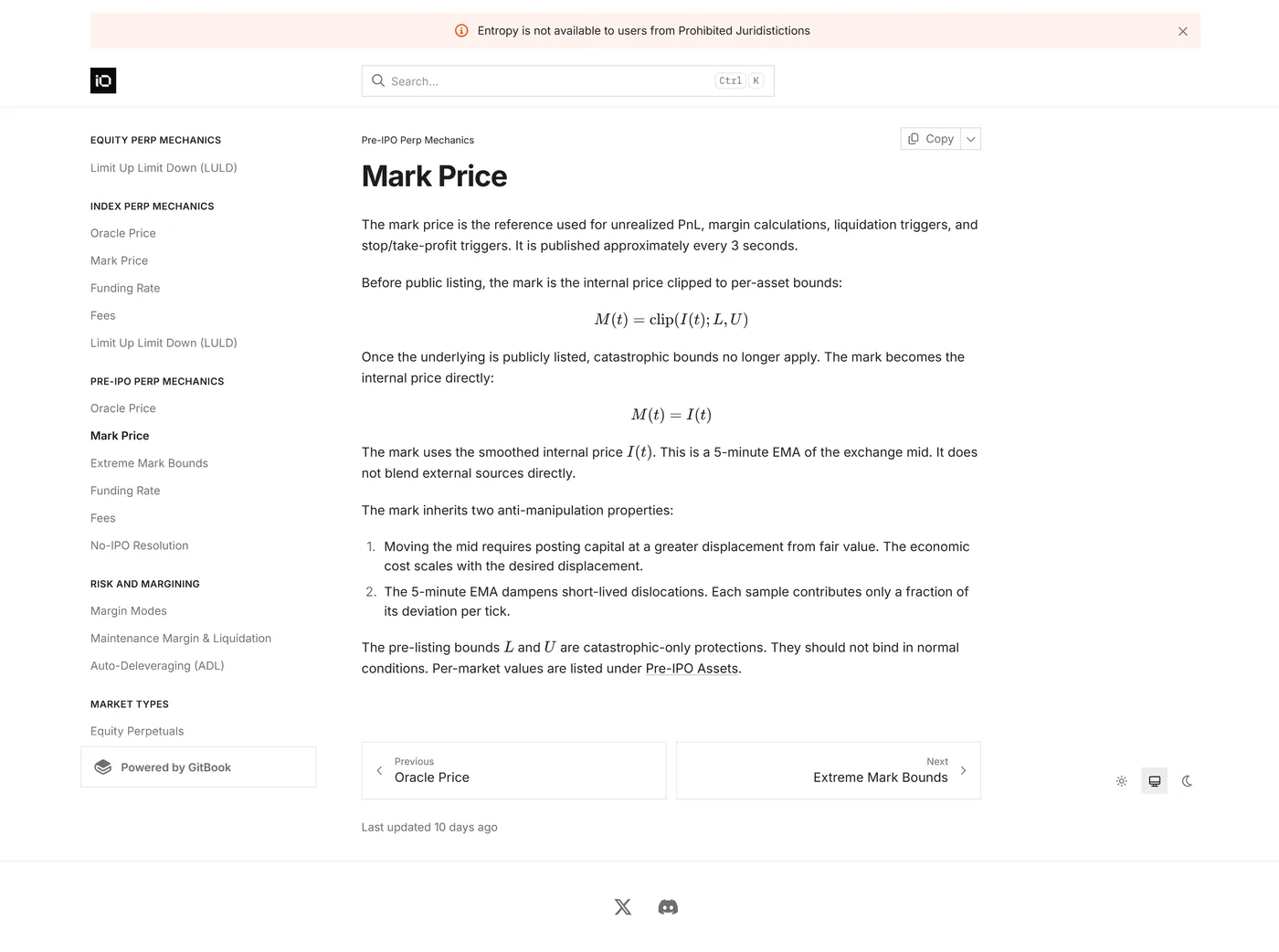
The mark, for pre-IPO markets, is simply clip(I(t), L, U). That is the internal EMA, clipped to the extreme bounds, with no external blend at all. Entropy's docs are explicit that the mark drives "unrealized PnL, margin calculations, liquidation triggers, and stop/take-profit triggers."
So on a pre-IPO market, the number that liquidates you comes from the venue's own order book, and the number that touches an external reference is the one that does not settle your PnL.
The structural weaknesses, stated plainly
This is where a pre-IPO perp differs from a crypto perp in ways that matter for sizing. None of the following is a leak or an accusation. It is all in the deployer's own documentation.
The mark is self-referential
On a BTC perp, an oracle drawn from several deep external venues makes single-venue manipulation expensive. On a pre-IPO perp, there is no deep external venue, because the underlying is private. The mark falls back on the venue's own mid. The five-minute EMA smooths noise, but smoothing an internal price does not make it external.
The external oracle is not auditable
Entropy's docs state that the scoring and aggregation procedure for the external aggregate is "internal". The external sources are not enumerated, the weighting is not published, and the aggregate carries at most a small minority weight in the oracle and none in the pre-IPO mark. You cannot reproduce the number from public data.
Trades can execute outside the bounds
The extreme mark bounds look like circuit breakers. They are not. Entropy's docs say: "The order book remains unrestricted... Trades may execute outside the bounds. Only the published mark and oracle are clipped." A thin book at 3am can fill you well outside the range that the published mark is allowed to display.
There is no liquidator vault, so ADL is the first fallback
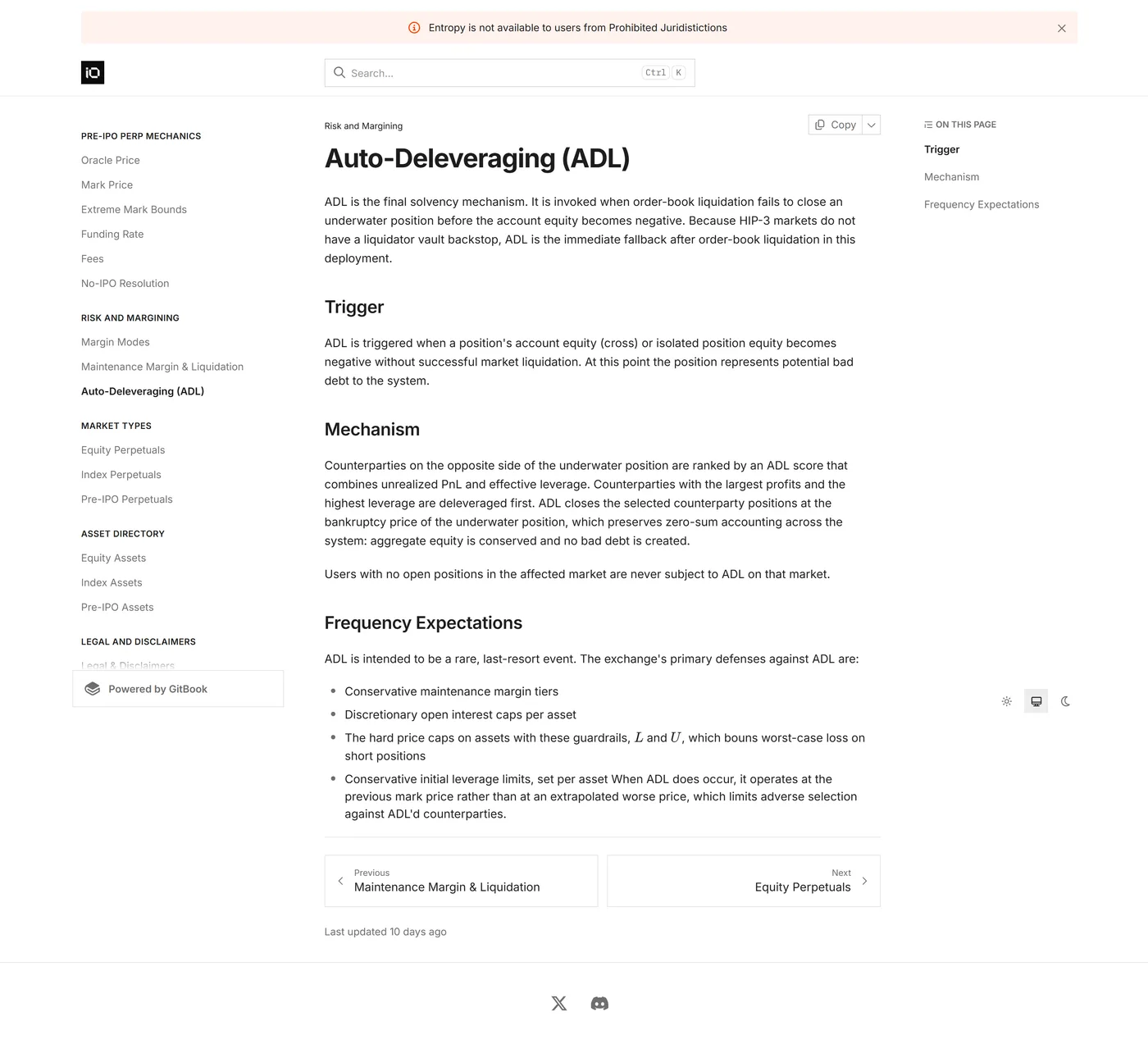
On  Hyperliquid's own core perps, HLP absorbs liquidations that the book cannot. HIP-3 markets do not have that. Entropy's docs: "Because HIP-3 markets do not have a liquidator vault backstop, ADL is the immediate fallback after order-book liquidation." And: "ADL cannot be opted out of."
In practice that means a correct, profitable, well-margined position can be closed by the system because someone else on the other side blew up and the book could not absorb it. On a market with a $5 million open interest cap and a thin book, this is not a tail scenario.
The settlement path may never touch reality
Entropy's pre-IPO markets carry a scheduled no-IPO resolution two years after listing. For io:ANTH that is 2028-08-18. If the company is still private on that date, the contract settles to the 30-day trailing time-weighted average of the mark, and the mark is the internal EMA.
A perpetual with no expiry normally relies on funding to tether it to a spot reference. A pre-IPO perp has no spot reference. Its terminal event, if the IPO never comes, is an average of its own recent prices. Alea Research made this the central criticism in its 2026-08-25 analysis, and it is the right thing to argue about. There is no arbitrage that forces convergence, because there is nothing external to converge to.
Funding barely moves on pre-IPO markets
Entropy's funding multiplier m differs by market type, and the spread is large.
| Market type | Funding multiplier m |
|---|---|
Pre-IPO (io:ANTH) | 0.00125, described in Entropy's docs as "roughly one-eighth of the Hyperliquid default" |
| Equity, market hours | 0.5 |
| Equity, outside hours | 0.125 |
The observable effect is that funding on a pre-IPO market is a small number. Carrying a directional position for weeks costs relatively little, which suits an instrument whose thesis plays out over quarters rather than hours. Funding is peer to peer and Entropy states that "the exchange takes no fee on funding payments."
The trade-off comes from the same fact. Funding is the mechanism that punishes a persistently one-sided book. Dial it down and a crowded long can sit at a stretched price for a long time without paying much for the privilege. On markets where the mark is internal anyway, that removes one of the few remaining forces pushing the price toward anything.
We do not speculate on why the multiplier is set where it is. The parameter is published, it is operator-adjustable, and those are the effects.
Two incidents worth studying before you size a position
Pre-IPO and equity perps have a short history, and the interesting failures have all come from price inputs, not from the matching engine.
Ventuals' SPACEX perp, May 2026. The vntl:SPACEX market fell roughly 45% in about 30 minutes after a vendor price feed returned bad data. Roughly 1,393 positions across about 400 wallets were liquidated. The deployer chose to compensate affected traders on a discretionary basis, which The Block covered at the time. Read the word "discretionary" carefully. There was no rule entitling anyone to compensation. A deployer decided.
trade.xyz's SK Hynix perp. The xyz:SKHX equity perp fell about 19% on a single share printing at an outlying price on a Korean pre-market venue. One share, at one venue, in a thin session, moved a leveraged derivative by a fifth.
Neither venue was hacked and neither clearinghouse failed. In both cases an input that nobody was watching closely enough became the price of record for long enough to liquidate people. That is the specific risk of this product class, and it is why the identity of the price source is the first question to ask about any pre-IPO market.
Entropy itself has no publicly reported incident. It is also seven days old, which means the absence of incidents carries essentially no information. Our is Entropy safe page treats that honestly.
How to evaluate any pre-IPO perp before trading it
A checklist that travels across venues:
- Who is the deployer? Read the ticker prefix.
io:is Entropy,xyz:is trade.xyz,para:is Paragon. The deployer sets every parameter and holds the halt key.
 - What produces the mark? If the answer is the venue's own book, size for that.
- What are the bounds, and do they bind the book or only the published price?
- What is the open interest cap, and how much is used? A near-full cap blocks new positions. See cannot open a position.
- What is the resolution date and the no-IPO settlement rule?
- What is the leverage ceiling and the margin mode? io:ANTH is 3x and strictly isolated.
- Is there a liquidator vault, or does ADL fire first?
- What do the fees actually come to? Headline HIP-3 rates and effective rates differ by 10x when Growth Mode is on. Our fees guide works through it.
Where this leaves the product
Pre-IPO perps solve a real problem. Private-market exposure has historically required accreditation, six-figure minimums and per-side fees measured in whole percentage points, and the venue comparison shows how wide that gap still is. A cash-settled perp with a $10 minimum and no accreditation gate is a genuinely different offer.
It solves it by replacing a claim on an asset with a claim on a number, and then producing that number internally. Both halves of that sentence are true at the same time. Traders who understand the second half can price the first. Traders who think they bought Anthropic exposure with a share behind it have misread the product, and the venue's own documentation says as much in plain language.
Get a 25% Rebate on Every Trade
Sign up through our link and Entropy attaches its 25% referral benefit to your account automatically, paying back a share of every trade for as long as you trade. It can only be attached at signup and can never be added afterwards, so anyone who arrives without one pays the full rate permanently.
Claim Your 25% RebateEntropy's referral rebate is calculated against Entropy's share of the HIP-3 fee, not your total fee, so the entry tier's headline 25% works out to roughly 12.5% of what you actually pay. It applies only to Entropy's own two markets, not the 317 aggregated ones. Full detail on the referral page, and our methodology explains how the figures above were sourced.
Frequently Asked Questions
A pre-IPO perpetual is a cash-settled futures contract with no expiry date that tracks a private company's implied valuation. It is collateralized and settled in stablecoins, it conveys no ownership of the company, and it delivers nothing at expiry because it has no expiry. On Entropy's HIP-3 markets the contract is denominated in billions of dollars of market capitalization, so each $1 of price represents $1 billion of implied company value rather than a share price.
No. Entropy's legal page states that its contracts are not equity, securities entitlements, ownership interests, IPO allocations or tokenized shares, and that holders receive no allocation rights or delivery rights. If the referenced company goes public, the market follows an IPO conversion path defined by the venue rather than distributing stock. You hold a cash-settled position in USDC throughout.
On Entropy's pre-IPO markets the mark price is a five-minute exponential moving average of the mid price on Entropy's own order book, clipped to fixed upper and lower bounds. Entropy's documentation states that the pre-IPO mark does not blend external sources directly. A separate liquidity-weighted oracle blends an internal price with an external aggregate, with the internal weight capped at 0.95 so at least 5% external weight is retained, but Entropy's docs state that the scoring and aggregation procedure for that oracle is internal.
Entropy's pre-IPO markets carry a scheduled no-IPO resolution date two years after listing. For io:ANTH that date is 2028-08-18. If the company is still private, the contract settles to the 30-day trailing time-weighted average of the mark price, which is derived from Entropy's own order book. Alea Research has published the critique that this settlement path never converges to an external valuation. Entropy's documentation also allows the market operator to issue an early resolution notice.
Yes, on other venues. In May 2026 the SPACEX pre-IPO perpetual deployed by Ventuals fell roughly 45% in about 30 minutes after a price feed returned bad data, liquidating around 1,393 positions across roughly 400 wallets, and the deployer compensated affected traders on a discretionary basis. Separately, a SK Hynix equity perpetual deployed by trade.xyz fell about 19% on a single share printing at an outlying price on a Korean pre-market venue. Both incidents involved price inputs rather than the underlying matching engine.
Independent resource: EntropyGuides is an independent, third-party resource operated by Concept211. It is not affiliated with, produced by, reviewed by or endorsed by Entropy, Bursa Global Inc., Hyperliquid, Hyper Foundation or Hyperliquid Labs. "Entropy", "Hyperliquid" and related names and marks belong to their respective owners and are used here only to identify the platforms this site documents. Read the full disclaimer.
Not advice: Nothing on this site is legal, tax, financial or investment advice. Descriptions of regulatory status, tax treatment and market availability are general information that varies by jurisdiction and changes over time. Confirm anything that matters to you with a qualified professional and against primary sources. Trading perpetual futures involves substantial risk of loss, and past performance does not indicate future results.
Disclosure: this site contains referral links. Signing up through our referral link applies an automatic rebate to your account and earns us a share of the fee Entropy already charges, at no extra cost to you. The rebate is quoted against Entropy's roughly 50% share of the fee, so the entry tier's headline 25% works out to about 12.5% of what you actually pay.
Get a 25% Rebate on Every Trade
Sign up through our link and Entropy attaches its 25% referral benefit to your account automatically, paying back a share of every trade for as long as you trade. It can only be attached at signup and can never be added afterwards, so anyone who arrives without one pays the full rate permanently.
Claim Your 25% Rebate