HIP-3 Explained: Builder-Deployed Perpetuals on Hyperliquid
Researched and written by Concept211 from Entropy's own docs, its public API and on-chain data. Not sponsored, reviewed or approved by Entropy, Bursa Global or Hyperliquid. We earn a referral share if you sign up through our link. How we research
Table of Contents
- Who is responsible for what
- The bond: 500,000 HYPE for 183 days
- The auction for extra markets
- Fees: set by Hyperliquid, not by the deployer
- Growth mode, and the part that costs you something
- Slashing: the rules, verbatim
- Nobody has been slashed, and that is the interesting part
- What this means before you trade a prefixed ticker
 hyperliquid
HIP-3 is the reason there are perpetual futures on SanDisk, SpaceX and the S&P 500 sitting next to BTC on Hyperliquid. It is a framework that lets an outside team post a bond in HYPE and deploy its own perp markets, which then clear through Hyperliquid's matching engine, margin system and liquidation machinery exactly like a core perp does.
The deployer defines the contract and the price. Hyperliquid runs the exchange. That division is the whole design, and every practical consequence for a trader falls out of it.
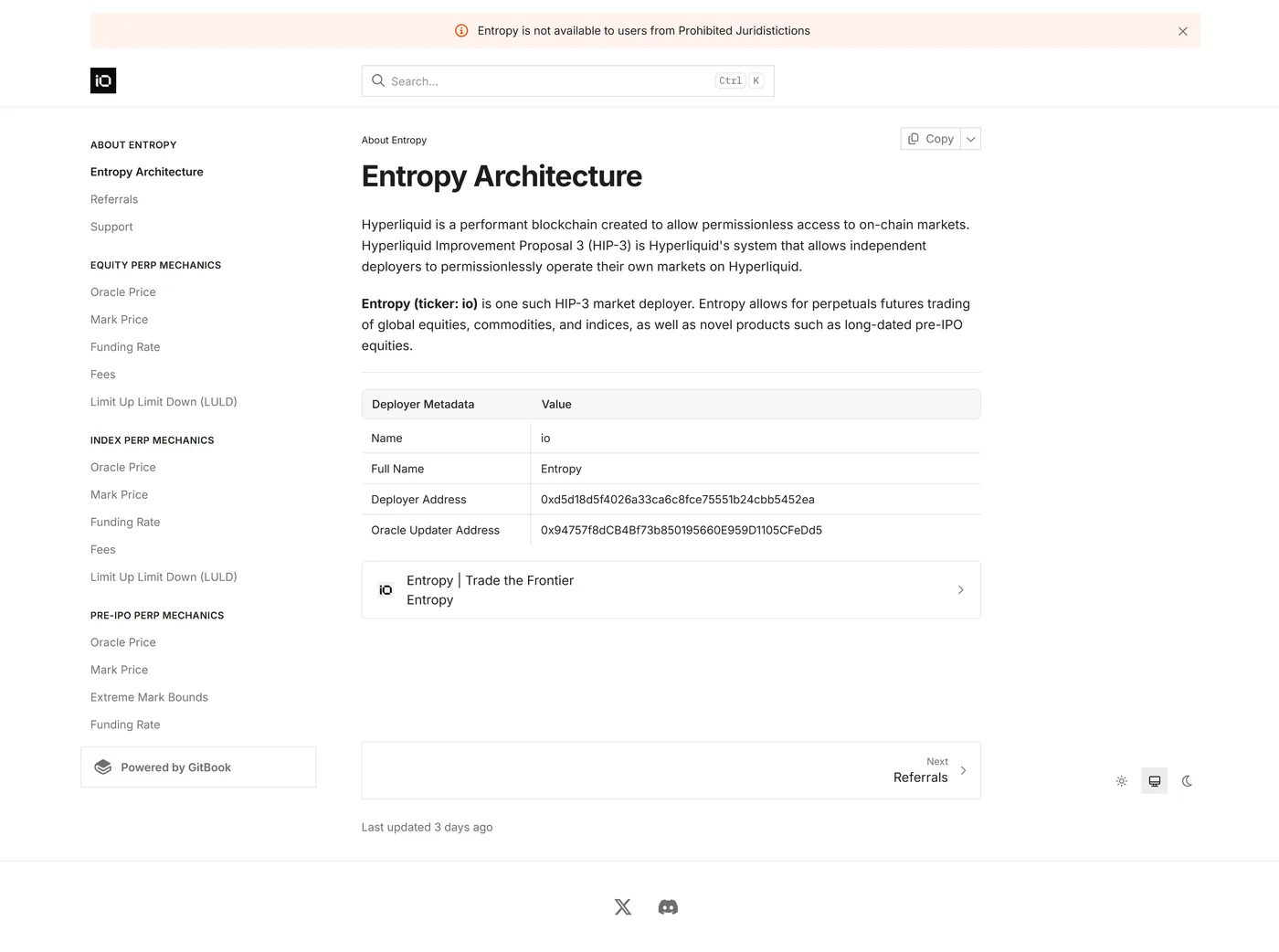
You can spot a HIP-3 market by its ticker prefix. io:ANTH is  Entropy's Anthropic contract.
 xyz:SPCX is trade.xyz's SpaceX contract. para:SMCI belongs to  Paragon. Plain
 BTC with no prefix is a Hyperliquid core perp.
Info
Disclosure. EntropyGuides is an independent third-party site with no relationship to Hyperliquid or to any HIP-3 deployer named here. Links to entropy.io carry our referral code. Nothing on this page is financial, legal or tax advice.
Who is responsible for what
This table is worth internalizing before you trade any prefixed ticker, because the answer to "who do I blame when this goes wrong" is different for each row.
| Function | Hyperliquid | The HIP-3 deployer |
|---|---|---|
| Matching engine and order book | Yes | No |
| Margin, liquidation, ADL | Yes | No |
| Fee schedule floor | Yes | No |
| Contract specification | No | Yes |
| Oracle definition and oracle prices | No | Yes |
| Leverage limits, open interest caps | No | Yes |
| Halting trading and settling the market | No | Yes |
Hyperliquid's own HIP-3 documentation puts the deployer's job in two lines: "Market definition, including the oracle definition and contract specifications," and "Market operation, including setting oracle prices, leverage limits, and settling the market if needed."
The consequence people underrate is the oracle. On a core Hyperliquid perp, the oracle is a validator-computed median of major exchange prices. On a HIP-3 market it is whatever the deployer says it is, published by the deployer's own key. If that methodology has a hole in it, Hyperliquid's liquidation engine will still execute against it, correctly and immediately, because the engine has no opinion about whether the price is sensible.
The bond: 500,000 HYPE for 183 days
The entry requirement is the part everyone quotes, usually without the conditions attached.
Per the docs, "the staking requirement for mainnet will be 500k HYPE," and it must be "maintained for a minimum of 183 days after the dex is deployed." This is a bond, not a listing fee. The HYPE stays staked to a validator, it keeps earning staking rewards, and the deployer gets it back if it exits cleanly.  Ventuals did exactly that when it wound down its pre-IPO markets in June 2026, returning the 500k one to one.
Two details that get dropped:
- The stake is slashable while you are leaving. "Even if the deployer has unstaked and initiated a staking withdrawal, the stake is still slashable during the 7-day unstaking queue."
- It stacks. A separate deployer role under a different HIP requires its own bond. You do not get to reuse one 500k position across obligations.
At HYPE prices in the low eighties, a 500k position is somewhere north of $40M of locked capital. That is the real filter on who becomes a deployer, and it is why the deployer list is short rather than permissionless in practice.
The auction for extra markets
The bond gets you a perp DEX. It does not get you unlimited markets.
Per the HIP-3 documentation, "the first 3 assets deployed in any perp dex do not require auction participation." Beyond that, additional assets go through a Dutch auction sharing the same hyperparameters as the HIP-1 spot auction, which runs on a 31 hour cadence, opens at twice the previous clearing price, and decays linearly to a floor of 500 HYPE.
Deployers also accrue headroom over time. The docs specify 7 + 0.2 * n_auction_deployments reserve deployments, which can be used at the current auction price while bypassing the auction timer. In plain terms, a deployer that keeps paying into auctions earns the right to list faster later.
This is why market counts across deployers look so uneven. Running 101 markets, as  trade.xyz does, represents a sustained cash outlay on top of the bond. Running two, as Entropy does, costs nothing beyond the bond. Neither number tells you anything about quality on its own, but it does tell you about commitment.
Fees: set by Hyperliquid, not by the deployer
This is the most consistently misreported part of HIP-3, and it kills a whole category of marketing claim.
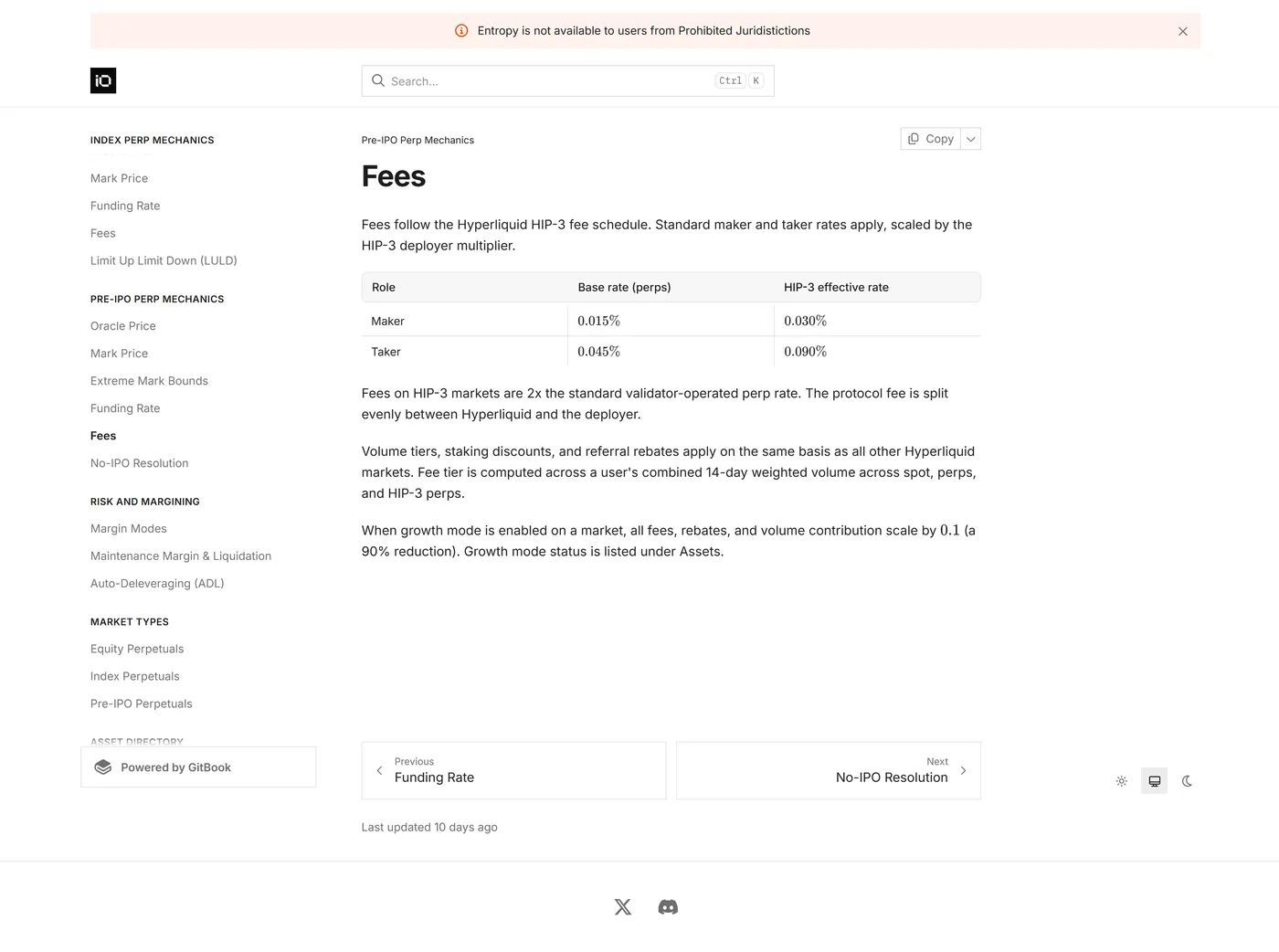
Fees on HIP-3 markets are 2x the standard validator-operated perp rate, and the protocol fee is split evenly between Hyperliquid and the deployer. So the schedule looks like this:
| Role | Hyperliquid core perp | HIP-3 base rate | With growth mode |
|---|---|---|---|
| Maker | 0.015% | 0.030% | 0.0030% |
| Taker | 0.045% | 0.090% | 0.0090% |
A deployer's only pricing lever points upward. Per the docs, "HIP-3 deployers can configure an additional fee share between 0-300% (0-100% for growth mode)," and "if the share is above 100%, the protocol fee is also increased to be equal to the deployer fee." There is no setting that prices a HIP-3 market below the schedule.
Most deployers leave the multiplier at 1x, so most HIP-3 markets cost exactly the same to trade.  HyENA is the visible exception, publishing 0.0500% taker and 0.0167% maker, which works out to roughly a 1.11x multiplier. Paragon and Markets by Kinetiq do not publish a percentage at all, and their implied all-in rates back out of observed fee revenue rather than a rate card.
So when a HIP-3 venue advertises "low fees," check what it is actually claiming. In almost every case it is describing a schedule it inherited and shares with every one of its competitors. Volume tiers and HYPE staking discounts also apply on the same basis across spot, core perps and HIP-3 perps, computed on your combined 14 day weighted volume, so those are not deployer-specific either. We break the arithmetic down in Entropy fees explained.
Growth mode, and the part that costs you something
Growth mode is a per-market Hyperliquid setting that scales all fees, rebates and volume contribution by 0.1, a 90% reduction. It exists to break the cold start problem: a brand new market has no liquidity because it has no volume, and no volume because it has no liquidity.
The headline effect is that a growth mode HIP-3 market is cheaper to take on than a Hyperliquid core perp. At 0.0090% taker, io:ANTH and io:SNDK cost one fifth of the 0.045% you would pay taking BTC on core. That is real, and it is verifiable: $66,194,725 of 24h notional on the io dex at 0.009% implies $5,958 of fees, against $5,982 reported by DefiLlama for the same window on August 26, 2026.
Two things to hold alongside it:
- Rebates scale down too. A maker rebate on a growth mode market is one tenth of the size. If your strategy earns rebates rather than paying fees, growth mode is a cost.
- Volume contribution scales down. Trading $10M of notional on a growth mode market advances your 14 day volume tier as if you had traded $1M. If you are working toward the 0.030%/0.004% tier at $100M, growth mode markets get you there ten times slower.
Growth mode is a switch any deployer can flip and several have. Both Entropy markets have had it enabled since August 19, 2026 at 14:12 UTC, and trade.xyz runs it on its markets as well. The correct read is "cheapest venue available today," not "structurally cheaper venue."
Slashing: the rules, verbatim
The 500k bond exists because a deployer sets prices that trigger liquidations on someone else's clearinghouse. Hyperliquid's remedy is validator slashing, and the docs are unusually blunt about how it works.
"In the event of malicious market operation, validators have the authority to slash" the deployer's stake by stake-weighted vote.
"Slashing is technical and does not distinguish between malicious and incompetent behavior."
That second sentence is the one to read twice. There is no good-faith defense written into the mechanism. A deployer whose oracle breaks because of a bug is exposed on the same terms as one that manipulates prices on purpose. The docs also extend the scope to exploiting "edge cases or loopholes that circumvent system limits."
The published guidelines scale the penalty to the damage:
| Conduct | Maximum slash |
|---|---|
| Irregular inputs causing invalid state transitions or prolonged network downtime | 100% |
| Irregular inputs causing brief network downtime | 50% |
| Invalid inputs causing network degradation or performance issues | 20% |
The amount actually applied is a stake-weighted median of validator votes, so these are ceilings rather than tariffs.
Warning
Notice what slashing is not. Slashed HYPE is a penalty against the deployer and a deterrent against bad market operation. It is not a compensation fund for traders, and nothing in the HIP-3 rules routes a slashed stake to the people who got liquidated. If a deployer's oracle prints a bad number and you are liquidated on it, the slashing mechanism does not make you whole.
Nobody has been slashed, and that is the interesting part
As of August 26, 2026, no publicly reported slashing of a HIP-3 deployer on Hyperliquid mainnet has been found. Hyperliquid's own documentation predicts as much: "in the most likely outcome, slashing never happens on mainnet."
That is not because nothing has gone wrong. Two mark price failures on HIP-3 markets in 2026 are on the public record, and both were resolved the same way, by the deployer voluntarily paying out.
Ventuals, SpaceX perp. The vntl:SPACEX contract plunged roughly 45%, and Ventuals compensated affected traders. Ventuals has since delisted all fifteen of its markets and returned its bond, which is worth knowing if you are following an old guide. We cover the wind-down and what replaced it in the Ventuals alternative page.
trade.xyz, SK Hynix perp. At approximately 23:01 UTC on July 27, 2026, the mark price on the SK Hynix perp fell from $1,127.90 to $917.25 in seconds, an 18.7% drop, liquidating a large book of longs. trade.xyz stated that its oracle worked as designed and that the trigger was an external market trade its methodology ingested. It then distributed USDC compensation, recalculating each eligible liquidation against a $1,115.50 reference price, and described the payout as a one-time discretionary measure that does not guarantee reimbursement after similar incidents in future.
Both outcomes are better for traders than a slashing would have been, since a slash pays nobody back. But note the mechanism: a deployer decided, on its own terms, to write a check. That is a commercial reputation decision, not a protocol guarantee, and the deployer said so explicitly. When you trade a HIP-3 market, your recourse after an oracle failure is whatever the deployer chooses to do.
What this means before you trade a prefixed ticker
A short checklist that generalizes across deployers:
- Read the oracle methodology. Is it a published formula with named external inputs, or is the aggregation described as internal? Entropy's pre-IPO mark, for example, is a clipped five-minute EMA of Entropy's own order book with no external blend, which is spelled out in is Entropy safe.
- Check the open interest cap. HIP-3 markets carry caps set by the deployer, and hitting one is the most common reason a position will not open.
- Check whether growth mode is on, both for the fee and for the volume tier effect.
- Assume ADL, not a vault. HIP-3 markets do not have a liquidator vault backstop, so auto-deleveraging is the immediate fallback after order book liquidation, and it cannot be opted out of.
- Look at how long the deployer has existed and how it behaved the last time something broke. That is a shorter list than you would hope.
The live comparison of every deployer, with volume, open interest and which ones are dead, is in HIP-3 deployers compared. For a worked example of a single deployer end to end, see Entropy on Hyperliquid, and for the head-to-head between the two largest, Entropy vs trade.xyz. If you want to actually place a trade on one of these markets, how to trade on Entropy walks through deposits and order entry.
Get a 25% Rebate on Every Trade
Sign up through our link and Entropy attaches its 25% referral benefit to your account automatically, paying back a share of every trade for as long as you trade. It can only be attached at signup and can never be added afterwards, so anyone who arrives without one pays the full rate permanently.
Claim Your 25% RebateImportant
This article is informational and is not financial, legal or tax advice. HIP-3 parameters are set by Hyperliquid and can change. Every figure here is stamped August 26, 2026 and was taken from Hyperliquid's HIP-3 documentation, the Hyperliquid info API, DefiLlama or the linked news coverage. Our sourcing rules are on the methodology page. Perpetual futures carry the risk of total loss.
Frequently Asked Questions
HIP-3 is Hyperliquid's builder-deployed perpetuals framework. It lets an outside team stake HYPE and deploy its own perpetual futures markets that clear through Hyperliquid's matching engine, margin system and liquidation infrastructure. The deployer defines the contract and the oracle. Hyperliquid provides the venue. Markets deployed this way carry a deployer prefix in their ticker, such as io:ANTH or xyz:SPCX.
The Hyperliquid documentation states that the staking requirement for mainnet is 500,000 HYPE, maintained for a minimum of 183 days after the dex is deployed. The stake is a bond rather than a fee. It stays staked and it remains slashable, including during the seven day unstaking queue if the deployer tries to withdraw it.
No, they are more expensive at the base level. Fees on HIP-3 markets are 2x the standard validator-operated perp rate, and that protocol fee is split evenly between Hyperliquid and the deployer. A deployer can configure an additional fee share on top, but cannot price below the schedule. The one large discount available is growth mode, a Hyperliquid setting that scales all fees, rebates and volume contribution by 0.1, and it is available to every deployer rather than to any one of them.
Growth mode is a per-market setting on Hyperliquid that multiplies all fees, rebates and volume contribution by 0.1, a 90 percent reduction. It is intended to help a newly deployed market get past the cold start problem where thin liquidity discourages volume and thin volume discourages liquidity. Because it applies to rebates and volume contribution as well as fees, trades on a growth mode market also count for one tenth as much toward your Hyperliquid volume tier.
No publicly reported slashing of a HIP-3 deployer on Hyperliquid mainnet has been found as of August 26, 2026. Hyperliquid's own documentation says that in the most likely outcome, slashing never happens on mainnet. The two notable mark price failures on HIP-3 markets in 2026, the Ventuals SpaceX perp and the trade.xyz SK Hynix perp, were both resolved by the deployer paying discretionary compensation to affected traders rather than by any validator action.
Independent resource: EntropyGuides is an independent, third-party resource operated by Concept211. It is not affiliated with, produced by, reviewed by or endorsed by Entropy, Bursa Global Inc., Hyperliquid, Hyper Foundation or Hyperliquid Labs. "Entropy", "Hyperliquid" and related names and marks belong to their respective owners and are used here only to identify the platforms this site documents. Read the full disclaimer.
Not advice: Nothing on this site is legal, tax, financial or investment advice. Descriptions of regulatory status, tax treatment and market availability are general information that varies by jurisdiction and changes over time. Confirm anything that matters to you with a qualified professional and against primary sources. Trading perpetual futures involves substantial risk of loss, and past performance does not indicate future results.
Disclosure: this site contains referral links. Signing up through our referral link applies an automatic rebate to your account and earns us a share of the fee Entropy already charges, at no extra cost to you. The rebate is quoted against Entropy's roughly 50% share of the fee, so the entry tier's headline 25% works out to about 12.5% of what you actually pay.
Get a 25% Rebate on Every Trade
Sign up through our link and Entropy attaches its 25% referral benefit to your account automatically, paying back a share of every trade for as long as you trade. It can only be attached at signup and can never be added afterwards, so anyone who arrives without one pays the full rate permanently.
Claim Your 25% Rebate