Is Entropy Safe? The Risks in Its Own Docs
Researched and written by Concept211 from Entropy's own docs, its public API and on-chain data. Not sponsored, reviewed or approved by Entropy, Bursa Global or Hyperliquid. We earn a referral share if you sign up through our link. How we research
Table of Contents
- The eight structural risks, in the platform's own words
- 1. Your liquidation price comes from Entropy's own book
- 2. The oracle keeps at most 5% external weight, and the method is undisclosed
- 3. Trades can execute outside the bounds even when the mark cannot
- 4. No liquidator vault, so ADL is the first fallback
- 5. One key can halt trading and settle everyone to mark
- 6. If Anthropic never IPOs, `io:ANTH` settles to Entropy's own average
- 7. The deployer stake is slashable up to 100%
- 8. The builder-fee approval authorizes more than what is charged
- The security posture, from the outside
- Custody
- Account security controls: none of the usual ones
- Infrastructure
- Audits and disclosure
- Third parties the privacy policy does not name
- Incidents: none on Entropy, and that means very little yet
- What you can actually control
EntropyGuides is an independent site with no relationship to Entropy. Links to Entropy carry our referral code. Everything below is observable from Entropy's documentation, terms, shipped code and on-chain state as of 2026-08-26. It is not legal, tax or investment advice, and it is not a verdict on any platform.
"Is Entropy safe" does not have a yes or a no. What it has is a set of documented mechanics, most of which Entropy publishes itself, and a security posture you can inspect from outside. This page lays out both and quotes the source wherever the exact wording matters. The conclusion is yours to draw.
io:ANTH, the mark price that triggers your liquidation is a 5-minute average of Entropy's own order book, and it "does not blend external sources directly". There is no liquidator vault behind it, so auto-deleveraging is the first fallback and "cannot be opted out of". Both quotes are from Entropy's documentation. Entropy is a HIP-3 builder-deployed perpetuals venue and frontend on
  Hyperliquid, operated by Bursa Global Inc., a company incorporated under the laws of the Republic of Panama. Its first trade was 2026-08-19. It deploys two markets of its own,
 io:ANTH and io:SNDK, and aggregates 317 more that belong to other deployers.
The eight structural risks, in the platform's own words
These are not hypotheticals or criticisms. Seven of the eight are documented by Entropy or by Hyperliquid's HIP-3 specification. Take them as a checklist before you size anything.
1. Your liquidation price comes from Entropy's own book
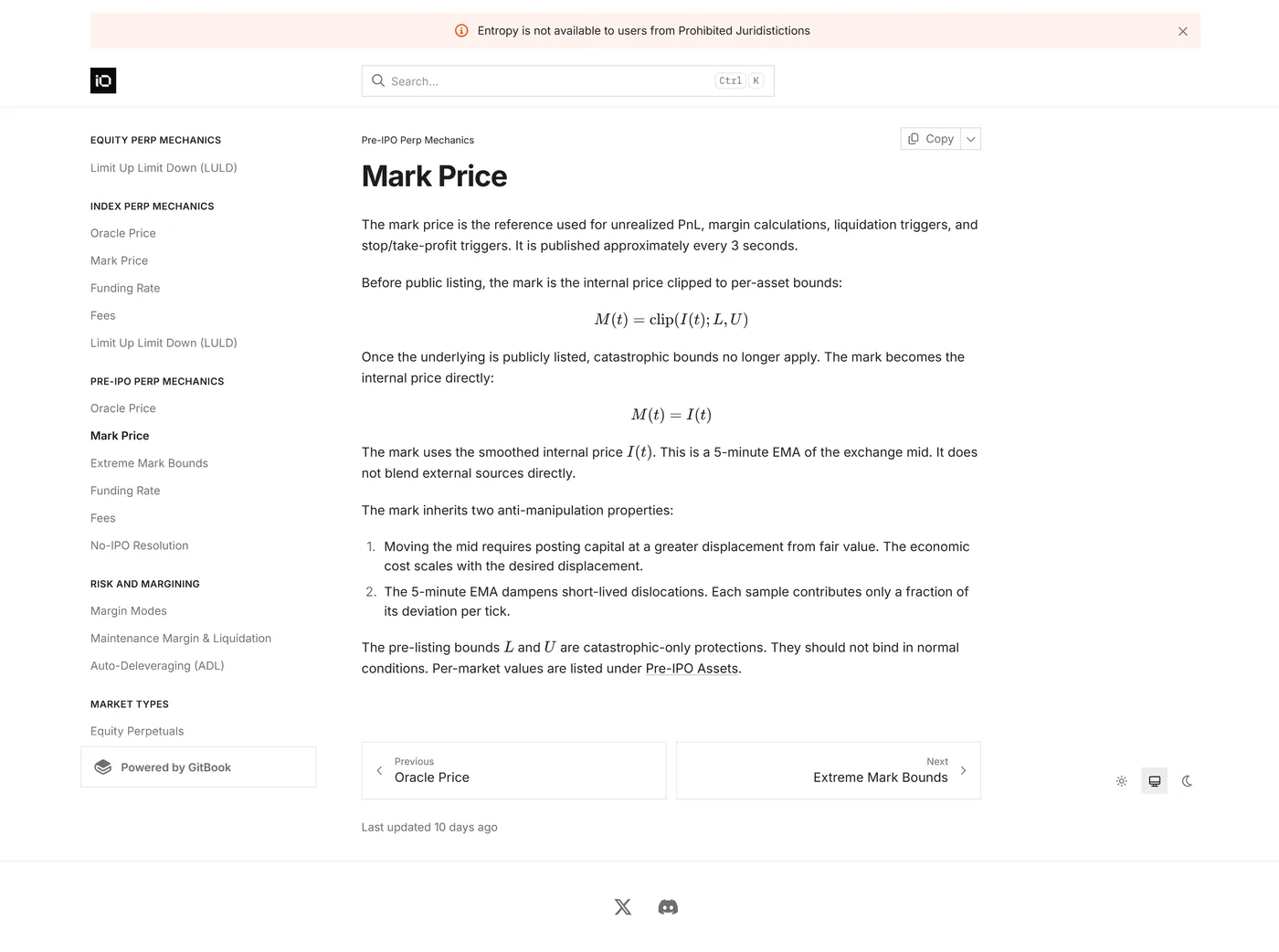
For pre-IPO markets, the mark is clip(I(t), L, U), where I(t) is a 5-minute exponential moving average of the mid price on Entropy's own order book. The docs say it "does not blend external sources directly". They also say the mark drives "unrealized PnL, margin calculations, liquidation triggers, and stop/take-profit triggers."
Put those two sentences next to each other. On io:ANTH, a market whose 24 hour notional was $13.6M on 2026-08-26, the price that closes your position is derived from the same book you are trading in. A thin book at an odd hour is not an abstraction, it is your margin calculation.
Equity markets like io:SNDK work differently. During market hours the mark is the average of a published external price and an internal price index, which anchors it to a real exchange. Outside market hours it falls back to a clipped internal price. The asymmetry is worth knowing: the equity market has an external anchor for part of the day, the pre-IPO market never does.
2. The oracle keeps at most 5% external weight, and the method is undisclosed
Entropy publishes a liquidity-weighted oracle, updated roughly every 3 seconds, that blends the internal price with an external aggregate. The weight is set by two-sided executable depth within 200 basis points of mid, with each resting order discounted by a decay function. The internal weight caps at 0.95, so the external component retains at least 5%.
On the external side, the docs state: "The scoring and aggregation procedure is internal." Which sources, how they are weighted, and how a bad print is filtered are not published. Crypto Briefing has reported  RedStone as an oracle provider, but RedStone is named nowhere in Entropy's own documentation, so treat that as third-party reporting rather than a confirmed integration.
3. Trades can execute outside the bounds even when the mark cannot
io:ANTH has extreme mark bounds of L = 300 and U = 4,200, which in market-cap denomination means an implied Anthropic valuation floor of $300B and ceiling of $4.2T. Those bounds sound like circuit breakers. They are not. The docs are explicit:
"The order book remains unrestricted... Trades may execute outside the bounds. Only the published mark and oracle are clipped."
So a fill can print at a level the mark will never show. If you are watching mark price to decide whether a wick was real, you are watching the clipped number, not the executions.
Separately, the docs note that L, U and other market parameters "may be updated at the market operator's discretion". Bounds are operator settings, not protocol guarantees.
4. No liquidator vault, so ADL is the first fallback
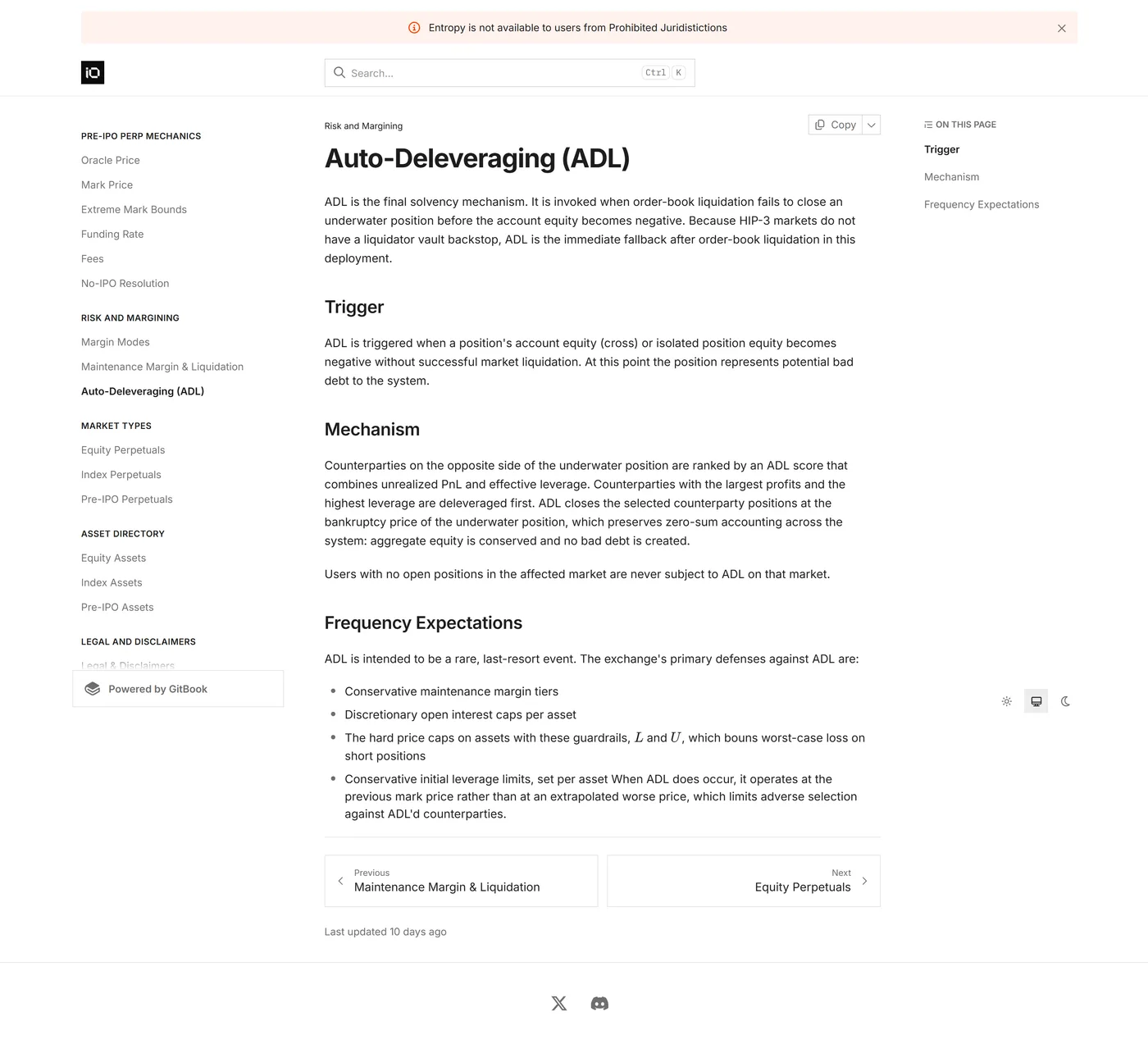
"Because HIP-3 markets do not have a liquidator vault backstop, ADL is the immediate fallback after order-book liquidation."
"ADL cannot be opted out of."
Hyperliquid's core perps have a liquidator vault behind the liquidation engine. HIP-3 markets do not. When an order-book liquidation cannot clear, the system deleverages counterparties, starting with the most profitable and most leveraged. A winning position can be closed at the mark, at a time you did not choose. This applies to every HIP-3 deployer, not just Entropy.
Entropy does soften the first stage: positions above $100K notional get an initial liquidation order at 20% of the position plus a 30-second cooldown, rather than a single market dump. That reduces the odds of a cascade. It does not remove ADL from the chain of events.
5. One key can halt trading and settle everyone to mark
The io dex splits its powers across four addresses. Root deployer 0x320c...cac6 holds the 500,413.09 HYPE stake. A separate hot key, 0xd5d1...52ea, holds registerAsset, setFeeRecipient, setMarginModes, setDeployerFees and haltTrading. A fourth key controls open-interest caps, margin tables and funding multipliers.
Per Hyperliquid's HIP-3 documentation, haltTrading "cancels all orders and settles positions to the current mark price." One compromised or misused hot key therefore ends every open position at whatever the mark happens to be. There is no timelock, no multisig requirement published, and no announced key-management policy.
Worth noting for accuracy: Entropy's docs list 0xd5d1...52ea as the deployer, but on-chain that address is a sub-deployer holding zero HYPE. The staked root is 0x320c...cac6. Documentation and chain state disagree.
6. If Anthropic never IPOs, io:ANTH settles to Entropy's own average
The scheduled resolution date is T0 + 2 years, which for io:ANTH is 2028-08-18. If no qualifying event has occurred, the contract settles to the 30-day trailing TWAP of the mark price. The mark, as established above, is Entropy's own book.
The contract therefore never converges to an external valuation. It converges to a month of its own trading. Alea Research raised this as the central critique of the design in an August 2026 note. The operator may also issue early notice of resolution.
7. The deployer stake is slashable up to 100%
HIP-3 requires 500,000 HYPE staked and held for at least 183 days to run a deployer. Entropy staked 500,413.09 HYPE in a single action on 2026-08-12 at 14:32 UTC, delegated to the "Kinetiq x Hyperion" validator at 4% commission. At HYPE around $81.71 that is roughly $40.9M.
Per the HIP-3 documentation, that stake is slashable up to 100% for invalid state transitions or prolonged downtime. This is a bond on operator behavior, which is a point in favor of the design, and it is also a risk to the operator that could affect the venue you are trading on.
Info
That $40M figure has been widely misreported as a "$40M Anthropic stake". It is not. Entropy's announcement described $14M in funding led by  Ribbit Capital and a $40M HYPE stake as two separate things. The HYPE is the HIP-3 deployer bond. No investment in Anthropic is involved, and Entropy's own legal page states it has "no affiliation with, endorsement from, or contractual relationship with any referenced issuer".
8. The builder-fee approval authorizes more than what is charged
To trade, you must complete an onboarding step labeled "Approve builder fee". What that signature authorizes and what is currently charged are different numbers:
| Item | Value |
|---|---|
| Builder address | 0xcD254d2A328f7f67C7c6FEf930A4757516F7b601 |
| Currently configured charged rate | 0 |
| Accrued builder fees on that address | Zero (funded with exactly 100 USDC) |
| Clamp ceiling in the shipped code | 100 tenths of a basis point, or 0.1%, Hyperliquid's perp maximum |
maxFeeRate in the approval you sign | 1%, Hyperliquid's spot maximum |
| Mentions of "builder" in Entropy's docs corpus | Zero |
| Mentions in the ToS, privacy, security or risk pages | Zero |
You are charged nothing today. The signature permits raising the charged rate up to the code's 0.1% clamp without asking you again. We are reporting what the code does and what the approval says. We have no information about why it is configured this way and will not guess. Hyperliquid caps a wallet at 10 approved builders, which is worth remembering if you use several frontends.
The security posture, from the outside
Custody
ToS section 1.3: "At no time does the Company take custody or possession of digital assets held in a user's Wallet." Funds sit in your own Hyperliquid account. Three layers are worth separating:
| Layer | Who holds the key | What it can do |
|---|---|---|
| Master wallet | You (or  Privy, if you signed up by email) Privy, if you signed up by email) | Everything, including withdrawals |
| Privy embedded wallet | Privy, if created by email login | Signs as your master wallet |
| Browser agent key | Your browser's IndexedDB, AES-GCM-256 wrapped, valid ~179 days | Trades only. Cannot withdraw |
Email signup silently creates a Privy embedded wallet, which moves key management to a third party that is not Entropy and not fully you. Withdrawals require a separate HyperliquidTransaction:Withdraw signature from the master wallet, so the trading key alone cannot drain an account. Anyone with your browser profile does have a live trading key for up to 179 days.
Account security controls: none of the usual ones
Searching the entire shipped bundle for 2fa, totp, authenticator, passkey, webauthn, mfa, withdrawal whitelist, ledger and trezor returns zero matches. No two-factor authentication, no passkeys, no withdrawal address whitelist, no hardware-wallet handling.
That is normal for a wallet-signature product, where the signature is the authentication. It also means there is no second factor if your key is compromised, and no whitelist to blunt a drain.
Infrastructure
| Control | State |
|---|---|
| Content Security Policy | report-only, therefore not enforced, and permits script-src 'unsafe-inline' |
| HSTS | Enabled, 1 year, includeSubDomains |
| Clickjacking | x-frame-options: DENY, frame-ancestors 'none' |
| MIME sniffing | nosniff |
| Referrer policy | strict-origin-when-cross-origin |
| Permissions policy | Camera, microphone, geolocation and payment locked |
| Info leak | A 404 body exposes the internal origin entropy-bb66.railway.internal:3000 |
A report-only CSP is a real gap. The header is present, so an automated scanner may score it as configured, but the browser will not block anything it flags. Combined with unsafe-inline, the practical protection against injected script is currently none.
Audits and disclosure
No smart contract audit is claimed, DefiLlama records zero, and there is no bug bounty, no security certification, no security.txt, no safe-harbor language and no reward schedule. Vulnerability reports go to a support email address.
This is structurally consistent rather than negligent: Entropy deploys no contracts of its own. It configures HIP-3 markets on Hyperliquid's clearinghouse, so contract-level and matching-engine risk is inherited from Hyperliquid, which is separately audited and battle-tested at scale. That is context, not exoneration. What Entropy does control (oracle methodology, mark construction, market parameters, keys and the frontend) is exactly the part nobody has audited.
One more inconsistency worth flagging: Entropy's security page lists a single official domain, entropy.io. Entropy also operates entropy.trade, which redirects to entropy.io and hosts the api., faro. and assets. subdomains the app calls. A phishing page on a lookalike domain is easier to sell when the official list is incomplete. Two plausible future targets, entropy.markets and entropy.exchange, are parked and for sale. No active clone of entropy.io was found as of 2026-08-26 across the candidate domains we checked.
Third parties the privacy policy does not name
The app connects to *.privy.io, *.supabase.co, explorer-api.walletconnect.com, arb1.arbitrum.io, api.entropy.trade, faro.entropy.trade (a self-hosted Grafana Faro instance with session tracking enabled), assets.entropy.trade and Cloudflare Insights. None of those processors is named in the privacy policy, and section 4.2 does not list IP address among the data collected even though the geo endpoint derives your country from it.
There is no KYC. The gates are an IP geo-check, wallet screening (the shipped file is literally named elliptic-screening, though  Elliptic is named in no legal document), and a click-through attestation. From a US IP,
 entropy.io/api/geo/status returns restricted:true with "mode":"trading", which blocks trading rather than browsing. The ToS names the United States, Canada, Panama and the United Kingdom as restricted jurisdictions and prohibits VPN or proxy circumvention. We describe what the terms say and what the frontend does, and stop there. See restricted countries.
Incidents: none on Entropy, and that means very little yet
No security incident, exploit, oracle manipulation or bad-liquidation event on Entropy has been publicly reported. The platform's first trade was seven days before this article. An absence of incidents over seven days is what you would expect from any system, working or broken. It is not a track record.
The useful evidence comes from the neighbors, because these markets have already failed twice in public.
 Ventuals, SpaceX, 2026-05-28. The
 vntl:SPACEX perpetual fell around 45% in roughly 30 minutes, attributed in reporting at the time to bad data from an external pricing vendor rather than genuine trading. Around 1,393 positions across roughly 400 wallets were liquidated. The deployer compensated affected traders at its own discretion, with nothing in the protocol obliging it to. Ventuals wound down the following month. See where its markets went.
 trade.xyz, SK Hynix. The
 xyz:SKHX market has been reported to move roughly 19% on a single share printing, a reminder that an equity perp referencing a thinly-quoted foreign listing can be moved by one odd trade upstream.
Neither event happened on Entropy. Both illustrate the failure mode this category actually has: the oracle or the reference price breaks, positions liquidate at prices that were never real, and whether you are made whole is a discretionary decision by a private operator.
What you can actually control
- Size for the ADL case, not the stop-loss case. Your stop is triggered by the mark. ADL ignores your preferences entirely.
- Treat the extreme bounds as mark clipping, not trading limits. Fills can print through them.
- Watch the OI cap.
io:ANTHsat at 66.6% of its $5M cap on 2026-08-26. A full cap rejects new positions, including the one you wanted to open to hedge. See cannot open position. - Prefer a hardware-backed master wallet over email signup if you would rather not add Privy to your trust set.
- Understand that clearing site data destroys your agent key. You can create a new one, but Hyperliquid caps API agents per wallet.
- Keep withdrawals in mind as your real exit. They need a master-wallet signature, a $5 minimum, and a $1 bridge fee, or roughly $0.20 by the
 Circle CCTP route.
 - Know who runs the market you are in. Of 319 markets on Entropy's frontend, 317 are somebody else's. Named deployers and their powers are in the HIP-3 explainer and the deployer comparison.
- Ignore token and airdrop chatter. Entropy has no token and no points program, and at least four impersonator contracts appeared within a day of its funding announcement. Details in the token and airdrop page.
For the mechanics behind the risks above, see what is Entropy, the Anthropic pre-IPO market guide and how Entropy compares with trade.xyz.
Get a 25% Rebate on Every Trade
Sign up through our link and Entropy attaches its 25% referral benefit to your account automatically, paying back a share of every trade for as long as you trade. It can only be attached at signup and can never be added afterwards, so anyone who arrives without one pays the full rate permanently.
Claim Your 25% RebateThis page describes observable facts from public documentation, shipped code and on-chain state. It contains no legal, regulatory or tax conclusions, and nothing here says whether any product is lawful, suitable or advisable for you. Entropy's own legal page states these contracts are "not equity, securities entitlements, ownership interests, IPO allocations, tokenized shares" and that holders receive "no voting rights, dividend rights, information rights, registration rights, allocation rights, delivery rights". Read Entropy's terms and risk disclosure yourself, and consult a qualified professional. Our methodology covers sourcing, and the disclaimer covers the rest.
Frequently Asked Questions
No. Its terms of service state at section 1.3 that at no time does the Company take custody or possession of digital assets held in a user's Wallet. Collateral sits in your own Hyperliquid account as USDC bridged from Arbitrum One. Two nuances follow from that. If you sign up with an email address, Privy creates an embedded wallet for you and key management sits with Privy. And the browser trading key Entropy creates is stored in your browser's IndexedDB with a validity of roughly 179 days, so clearing site data destroys it. That key cannot withdraw funds, because withdrawals require a separate signature from your master wallet.
No. Grepping the entire shipped JavaScript bundle for 2FA, TOTP, authenticator, passkey, WebAuthn, MFA, withdrawal whitelist, Ledger and Trezor returns zero matches. The controls that do exist are wallet-signature authentication, Privy session tokens, the roughly 179-day browser agent key, a master-wallet signature requirement for withdrawals, a 5 dollar minimum withdrawal and a destination-chain acknowledgment. Entropy's security page lists four items: official domains, wallet safety, external services and a vulnerability reports email.
No smart contract audit is claimed, DefiLlama records zero audits, and there is no bug bounty, security.txt or published reward schedule. There is no publicly reported security incident, exploit or bad-liquidation event on Entropy. With a first trade on 2026-08-19, that absence reflects a very short history rather than a demonstrated track record. Entropy deploys no contracts of its own, so contract-level risk is inherited from Hyperliquid. Market configuration and oracle risk sit with Entropy.
Entropy's own order book. Its documentation states that the pre-IPO mark price is a clipped 5-minute exponential moving average of Entropy's internal mid price and does not blend external sources directly, and that the mark drives unrealized PnL, margin calculations, liquidation triggers, and stop and take-profit triggers. The mark is clipped to extreme bounds of 300 and 4,200 for io:ANTH, but the docs also state that the order book remains unrestricted and trades may execute outside the bounds. Only the published mark and oracle are clipped.
Yes. Entropy's documentation states that because HIP-3 markets do not have a liquidator vault backstop, auto-deleveraging is the immediate fallback after order-book liquidation, and that ADL cannot be opted out of. Separately, one operator key holds the haltTrading power, which per Hyperliquid's HIP-3 documentation cancels all orders and settles positions to the current mark price. These are properties of HIP-3 markets generally, not of Entropy alone.
Independent resource: EntropyGuides is an independent, third-party resource operated by Concept211. It is not affiliated with, produced by, reviewed by or endorsed by Entropy, Bursa Global Inc., Hyperliquid, Hyper Foundation or Hyperliquid Labs. "Entropy", "Hyperliquid" and related names and marks belong to their respective owners and are used here only to identify the platforms this site documents. Read the full disclaimer.
Not advice: Nothing on this site is legal, tax, financial or investment advice. Descriptions of regulatory status, tax treatment and market availability are general information that varies by jurisdiction and changes over time. Confirm anything that matters to you with a qualified professional and against primary sources. Trading perpetual futures involves substantial risk of loss, and past performance does not indicate future results.
Disclosure: this site contains referral links. Signing up through our referral link applies an automatic rebate to your account and earns us a share of the fee Entropy already charges, at no extra cost to you. The rebate is quoted against Entropy's roughly 50% share of the fee, so the entry tier's headline 25% works out to about 12.5% of what you actually pay.
Get a 25% Rebate on Every Trade
Sign up through our link and Entropy attaches its 25% referral benefit to your account automatically, paying back a share of every trade for as long as you trade. It can only be attached at signup and can never be added afterwards, so anyone who arrives without one pays the full rate permanently.
Claim Your 25% Rebate