SNDK on Hyperliquid: io:SNDK vs xyz:SNDK After the Split
Researched and written by Concept211 from Entropy's own docs, its public API and on-chain data. Not sponsored, reviewed or approved by Entropy, Bursa Global or Hyperliquid. We earn a referral share if you sign up through our link. How we research
Table of Contents
- Can you trade SNDK on Hyperliquid?
- io:SNDK vs xyz:SNDK
- What the SanDisk stock split did to SNDK perps
- Contract specification
- How io:SNDK is priced
- LULD: the 6.67% overnight band
- Funding
- Corporate actions, and what happens at the end
- Fees
- Risks specific to this market
- Who deploys what, and why it matters here
- Where io:SNDK fits
Warning
EntropyGuides is an independent, unofficial guide. We are not affiliated with Entropy, Bursa Global Inc., Hyperliquid, the Hyper Foundation or Hyperliquid Labs. Links to Entropy on this page are referral links. Nothing here is financial, legal or tax advice.
Can you trade SNDK on Hyperliquid?
Yes.  SanDisk (SNDK) trades on
 Hyperliquid as two separate perps.
io:SNDK is run by  Entropy with up to 15x leverage, and xyz:SNDK is run by
 trade.xyz with up to 10x. Both trade 24/7, settle in USDC and track one post-split SanDisk share.
- Two books, one stock.
xyz:SNDKhas most of the volume.io:SNDKallows more leverage. - The price near $84 is post-split. SanDisk split 8-for-1 on November 20, 2026. Positions on both perps were closed first and did not carry over.
- Overnight,
io:SNDKcan only trade about 6.67% either side of the session close. Orders through that band are rejected. - Taker fees are 0.0090% on both at the base tier, because both run growth mode.
io:SNDK vs xyz:SNDK
io:SNDK (Entropy) | xyz:SNDK (trade.xyz) | |
|---|---|---|
| Max leverage | 15x | 10x |
| Margin | Cross or isolated | Cross or isolated |
| 24h volume | $4.95M | $56.1M |
| Open interest | $7.3M | $46.5M |
| Open interest cap | $35M | $500M |
| Bid-ask spread, one snapshot | 3.6 bps | 1.0 bps |
| Base taker / maker fee | 0.0090% / 0.0030% | 0.0090% / 0.0030% |
| Entropy referral rebate | Yes | No |
The market figures are Hyperliquid API readings from November 23, 2026, around 07:15 UTC, which is the middle of the night in New York and a thin hour. Entropy had 8.1% of the two markets' combined volume. On August 26 it had 23.2%, so check the live volume rankings before you pick a book.
For most orders I would start with xyz:SNDK, because the spread is tighter and the base fee is the same. io:SNDK makes sense if you want more than 10x, or if you are collecting Entropy's rebate and your size fits its book.
Get a 25% Rebate on Every Trade
Sign up through our link and Entropy attaches its 25% referral benefit to your account automatically, paying back a share of every trade for as long as you trade. It can only be attached at signup and can never be added afterwards, so anyone who arrives without one pays the full rate permanently.
Claim Your 25% Rebate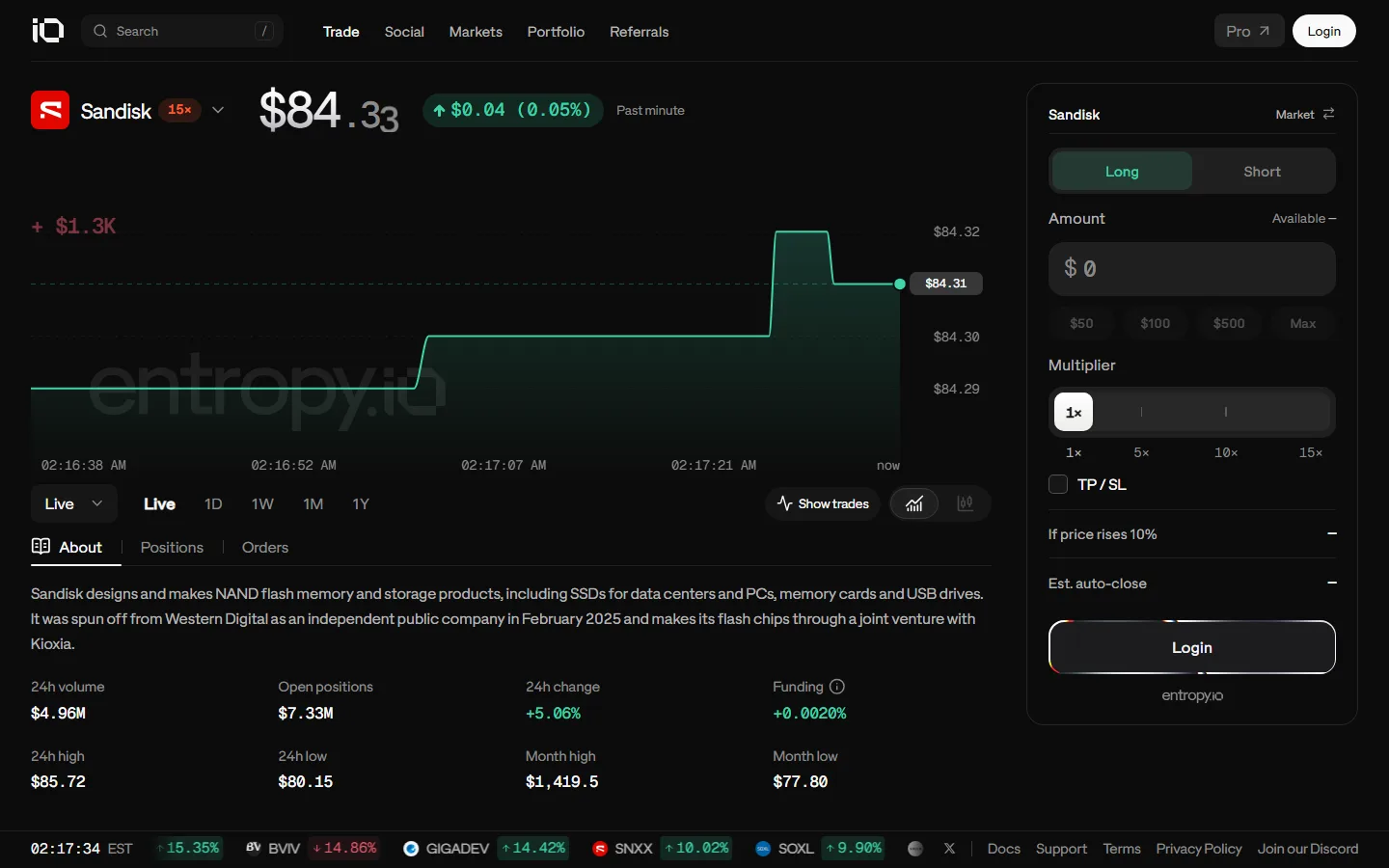
What the SanDisk stock split did to SNDK perps
SanDisk's board approved an 8-for-1 split on October 29, and the stock began trading on the new basis on Friday, November 20, 2026. Hyperliquid cannot rescale open positions, so each venue published a plan to settle its market and reopen it at one eighth of the price (Entropy's notice, trade.xyz's notice).
If you held SNDK into the close on November 19, the notices say your position was closed at the settlement price with the PnL realized in USDC. Every open order was canceled, including stops and take-profits. To get back in, you had to open a new position at post-split size.
io:SNDK | xyz:SNDK | |
|---|---|---|
| Scheduled reduce-only start | About 3:55 PM ET | 4:00 PM ET |
| Settlement price, per the notice | Closing price | Nasdaq closing auction price |
| Last trade before the halt | $752.23 | $753.69 |
| First trade back | $97.30, in the 4:30 PM ET candle | $92.583, in the 8:00 PM ET candle |
The last two rows come from Hyperliquid's 15-minute candles. Entropy reopened more than three hours before trade.xyz.
Charts still mix the two bases. A month high above $1,400 beside an $84 price is the split, and so is most of the near-90% drop on the November 19 daily candle. Multiply a post-split price by eight before comparing it with anything from before November 20.
Contract specification
| Parameter | Value |
|---|---|
| Symbol | io:SNDK |
| Reference issuer | SanDisk Corporation |
| Deployer | Entropy, HIP-3 ticker io |
| Quote and collateral | USDC |
| Maximum leverage | 15x |
| Margin mode | Cross |
| Open interest cap | $35M |
| Depth constant a | 1,000 |
| Growth mode | enabled, since August 19, 2026, 14:12 UTC |
| Market type | US Equity |
| Trading hours | 24/7 |
| Scheduled terminal date | none |
| First trade | August 19, 2026, 14:00 UTC |
Entropy's asset directory and the Hyperliquid API agreed on leverage, margin mode and the cap when we checked on November 23, 2026.
If you read an older version of this page, three of those rows have changed. In August the market was capped at 10x, reported strictly isolated margin, and had a documented cap of 5M against 10M in the API. Cross margin cuts both ways: other collateral can keep a losing SNDK position alive, and that position can then take the collateral with it. Choose isolated if you want the loss limited to what you assigned.
Open interest was about 21% of the cap, so there was plenty of room. If you do hit a cap rejection, cannot open position covers the diagnosis.
How io:SNDK is priced
An equity perp has a problem a crypto perp does not: the thing it references stops trading every afternoon. Entropy's specification handles this by running two distinct regimes and switching between them at the session boundary.
During SanDisk's regular cash session, the oracle is pinned to the public reference price:
O(t) = P_pub(t), and M(t) = (P_pub(t) + I₃(t)) / 2
The oracle is simply the public print. The mark, which is what drives your unrealized PnL, margin, liquidation triggers and stop and take-profit triggers, is the mean of the public print and a 3-minute EMA of Entropy's own mid. Entropy's stated rationale is that neither leg can move the mark by more than half of its own displacement, so a dislocation on one side is damped by the other.
Outside the cash session, there is no live public price, so the oracle becomes a liquidity-weighted blend of Entropy's internal price and an external price, and the mark becomes Entropy's own 5-minute EMA clipped to bounds centered on the last public print:
L = (1 − 1/ℓmax)·P_last, U = (1 + 1/ℓmax)·P_last, and M(t) = clip(I(t); L, U)
With ℓmax = 15 on io:SNDK, those bounds sit about 6.67% either side of the closing print. The slower 5-minute EMA is used overnight because the internal price is carrying the mark on its own without a public anchor.
The blend weight in the overnight oracle is driven by executable depth within 200bps of the mid, with each resting order discounted by an expected fill ratio ρ = 1/(1 + exp(0.15·d_bps)). The internal weight is capped at 0.95, so the external side always keeps at least 5% weight. Entropy describes the depth heuristic as intentionally omitting queue position, volatility and flow variables.
Entropy says RedStone supplies both the market-hours reference price and the after-hours external price.
Venue-declared intraday halts and stale-feed conditions during the regular session are treated as outside market hours until trading resumes or the feed recovers. That is worth remembering on a day SanDisk halts for news: the perp does not stop, it switches regime.
LULD: the 6.67% overnight band
This is the mechanic that will reject your order, and it is the one most people meet by surprise.
Outside the cash session, trading on io:SNDK is confined to a band placed one initial-margin fraction above and below the reference price. Let P_ref be the last published oracle value while the external feed was live, that is, the price at the moment SanDisk's session closed. P_ref is held fixed for the whole non-trading window and does not update from internal flow. With Λ = 15 as the market's maximum leverage, the initial margin fraction is 1/15, so:
P⁺ = P_ref × 1.0667, P⁻ = P_ref × 0.9333
Entropy's documentation is unambiguous about the consequence: "Orders that would execute through a band are rejected, and the market rests limit-up at P⁺ or limit-down at P⁻ until flow re-enters the band or the underlying's session reopens."
trade.xyz runs its stock perps, xyz:SNDK included, on a different off-hours model, with bounds that re-anchor instead of holding fixed; stock perps when Nasdaq is closed covers it. The same model applies to Micron's xyz:MU, another memory stock on that venue.
You can see what looks like the lower band in the split night's candles. Just after midnight ET on November 20, io:SNDK stopped at $88.11, printed that same low in candle after candle for over an hour, and spent two 15-minute candles trading at that price alone. xyz:SNDK went as low as $84.956 in the first 15 minutes of it. Entropy has not published the reference price it used, but $88.11 is one fifteenth below roughly $94.40.
So an overnight news event that would move SanDisk 15% cannot move io:SNDK more than about 6.67% until the cash session reopens and the bands are released. That protects the mark from being walked arbitrarily far by internal flow with no external price supporting the move. It also means the perp can sit pinned at limit-up while everyone who wants to buy is unable to, and it means a gap on the reopen is a real possibility rather than a theoretical one, because the bands are released and the oracle returns to its standard construction on the next tick.
Warning
Band width scales inversely with max leverage. The formula narrows the band from 10% to about 6.67% when the cap goes from 10x to 15x. A market with 5x max leverage gets a 20% band, and one with 25x gets 4%.
Funding
Funding accrues continuously and pays hourly. The hourly rate comes from the premium of the perpetual mid against the oracle using the standard Hyperliquid funding formula, scaled by a per-market multiplier m:
| Regime | Multiplier m |
|---|---|
| SanDisk market hours | 0.5 |
| Outside market hours | 0.125 |
The payment is Q × O(t) × f(t), where Q is position size and O(t) is the oracle price rather than the mark. Funding is peer to peer, and Entropy states plainly that the exchange takes no fee on funding payments.
The practical read: overnight funding on io:SNDK is damped to a quarter of its daytime scaling. A basis that opens up while the cash market is closed costs a quarter as much per hour to hold as the same basis during the session. If you carry positions across regimes, model the two multipliers separately.
Corporate actions, and what happens at the end
io:SNDK has no scheduled terminal date. An equity perp on Entropy runs until a corporate action ends the public reference feed. Entropy's documentation specifies three cases.
| Event | What happens |
|---|---|
| Cash dividend | No adjustment is applied. The oracle follows the public reference price through the ex-dividend date and the perpetual reprices with the underlying. |
| M&A or delisting | The market settles to the last price one day before SanDisk's final trading day on its primary venue, via haltTrading. |
| Stock split | Because position sizes cannot be resized on this venue, the market settles to the last price one day before the primary venue's ex-date via haltTrading. A successor market on the post-split basis may be listed once post-split public prices are observable. |
The dividend treatment is the one to internalize. A long position in io:SNDK does not receive the dividend and does not get compensated for the ex-date drop. You hold the price move without the cash. On a stock with a small yield this is noise. On a stock with a meaningful one it is a scheduled, known, one-directional cost of carrying a long across the ex-date, and it is the sort of thing a synthetic gives you that the underlying does not.
The split rule was used on November 19, 2026. The documentation only says a successor may be listed. This time Entropy reopened the same ticker the same evening.
Fees
HIP-3 markets are charged at twice the standard Hyperliquid validator-operated perp rate, with the protocol fee split evenly between Hyperliquid and the deployer. That is the published 0.030% maker and 0.090% taker. But io:SNDK has had growth mode enabled since August 19, 2026, which scales all fees, rebates and volume contribution by 0.1.
| Base perp | HIP-3 (2x) | With growth mode | |
|---|---|---|---|
| Maker | 0.015% | 0.030% | 0.0030% |
| Taker | 0.045% | 0.090% | 0.0090% |
In August 2026 we cross-checked the effective figure at the dex level rather than trusting the arithmetic alone: $66.19M of 24-hour io notional at 0.009% implied $5,958 of fees, and  DefiLlama reported $5,982 for the same window, a ratio of 1.00.
The qualification matters, though. Growth mode is a HIP-3 lever available to every deployer, and trade.xyz runs it on its markets too, reaching 0.00288% taker at its top volume tier. So on the SNDK head-to-head specifically, fees are not the differentiator. Liquidity is. Full working in Entropy fees explained.
Risks specific to this market
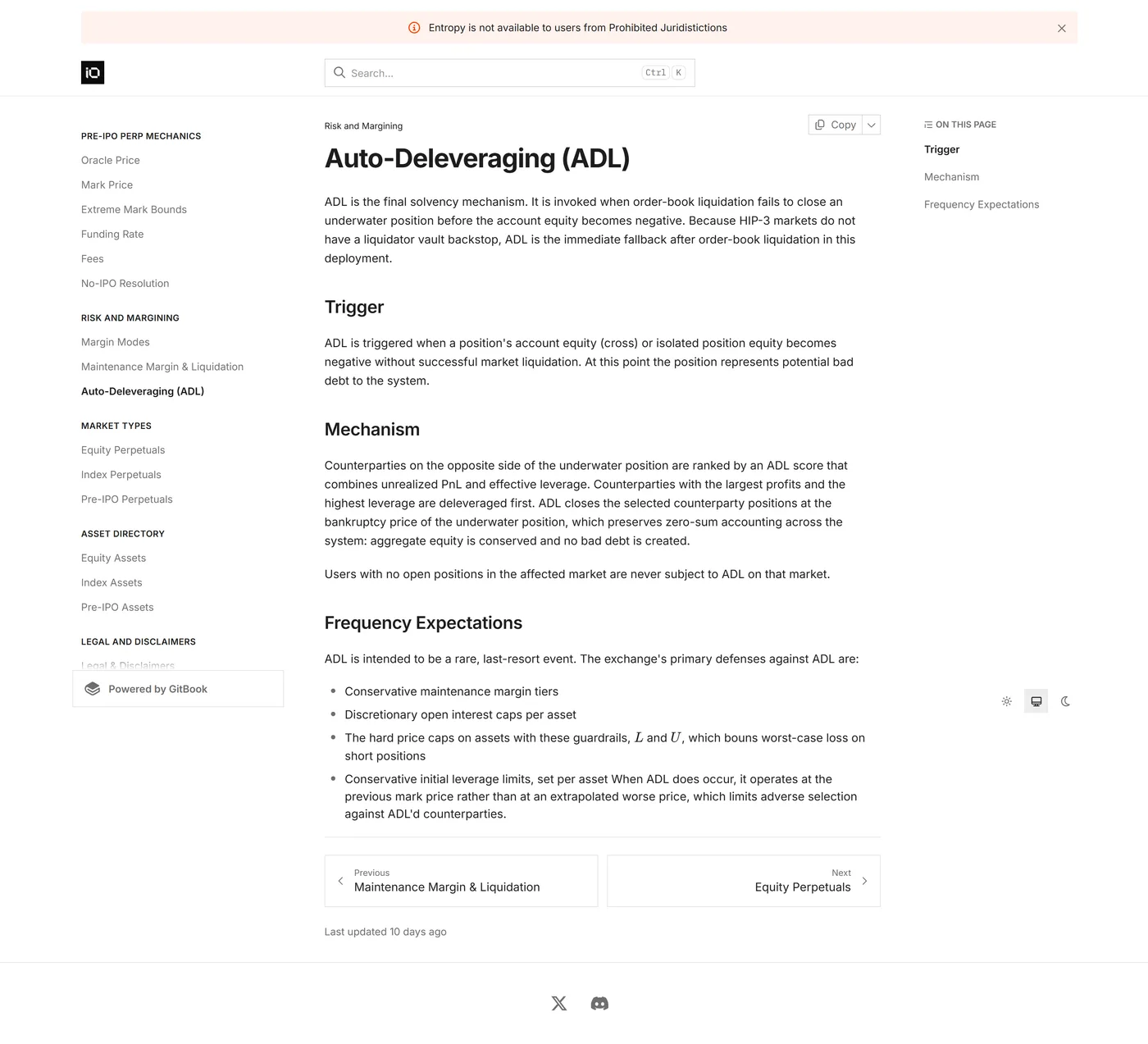
No liquidator vault backstop. Entropy's ADL page states that because HIP-3 markets do not have a liquidator vault backstop, auto-deleveraging is the immediate fallback after order-book liquidation. It also says an io liquidator vault is "to be opened soon." On a market whose book can be thin overnight while pinned at a band, that fallback is closer than it is on a core Hyperliquid perp.
Liquidations are mark-driven. The mark on io:SNDK is anchored to SanDisk's public print during the session, which is reassuring, and to Entropy's own clipped internal EMA outside it, which is less so. Maintenance margin is tiered, with r_mm set at half the maximum initial margin rate. Positions above $100K notional receive an initial liquidation order at 20% of the position followed by a 30-second cooldown.
One key can end the market. The registerAsset, haltTrading, setFeeRecipient, setMarginModes and setDeployerFees powers for the io dex sit on a single address. Per Hyperliquid's HIP-3 documentation, haltTrading cancels all orders and settles positions to the current mark price. That is the same mechanism the corporate-action rules above invoke, which means the operational path for an intentional wind-down and the operational path for an M&A settlement are identical.
The venue is young. The first io:SNDK trade was on August 19, 2026, so the market has about three months of history. Our full read is in is Entropy safe.
Who deploys what, and why it matters here
io:SNDK is Entropy's own market, deployed by Bursa Global Inc. under the io HIP-3 ticker. Entropy's frontend also shows markets deployed by others, xyz:SNDK included, and responsibility for their specification, pricing and settlement sits with whoever registered them. Check the prefix before you trade: the two SNDK books do not share liquidity, and a position on one cannot be closed on the other.
That also constrains the referral rebate. Entropy's tiers apply "only to activity on Entropy deployed markets", so io:SNDK can earn the rebate and xyz:SNDK cannot, whichever frontend you use. Your address has to have connected to Entropy and created an account first. And the tiers are calculated against Entropy's roughly 50% share of the HIP-3 fee rather than the fee you pay, so the entry tier's 25% works out to about 12.5% of your actual fees. Detail on our referral page.
Get a 25% Rebate on Every Trade
Sign up through our link and Entropy attaches its 25% referral benefit to your account automatically, paying back a share of every trade for as long as you trade. It can only be attached at signup and can never be added afterwards, so anyone who arrives without one pays the full rate permanently.
Claim Your 25% RebateWhere io:SNDK fits
If you want SanDisk exposure around the clock in USDC, io:SNDK gives you 15x, a mark tied to the public print during the session, and a 6.67% band outside it. Entropy's other market we cover is io:ANTH. The category mechanics are in HIP-3 explained, and the deployer comparison is in HIP-3 deployers compared.
To trade it you need USDC on Arbitrum One and a funded Hyperliquid account. Start with how to trade on Entropy and depositing USDC. Entropy blocks the United States and several other places, covered in Entropy restricted countries.
An equity perpetual is not equity, and Entropy says so in its own documentation. Nothing on this page is financial, legal or tax advice. Market figures were read on November 23, 2026, unless the text gives another date. See our methodology for how these numbers were pulled and our disclaimer for the rest.
Frequently Asked Questions
Yes. SanDisk trades on Hyperliquid as two separate HIP-3 perpetuals: io:SNDK, deployed by Entropy with up to 15x leverage, and xyz:SNDK, deployed by trade.xyz with up to 10x. Both are cash-settled in USDC, trade 24/7 and reference one post-split SanDisk share. Neither gives you shares, votes or dividends.
They were closed. SanDisk's 8-for-1 split took effect on November 20, 2026, and Hyperliquid cannot resize open positions, so Entropy and trade.xyz both scheduled a settlement after the Nasdaq close on November 19, canceled all open orders and reopened at one eighth of the closing price. Traders who wanted to keep exposure had to open a new position.
Outside SanDisk's regular cash session, io:SNDK is confined to a band set one initial-margin fraction above and below the last oracle value from the session. With maximum leverage of 15, that is about plus or minus 6.67 percent. Entropy's documentation says orders that would execute through a band are rejected until flow re-enters the band or the cash session reopens.
Cross is available. Entropy's asset directory lists SNDK as Cross, and the Hyperliquid API carried no isolated-only flag on io:SNDK when we checked on November 23, 2026. The market was strictly isolated with a 10x cap in August, so older guides that say so are out of date.
Funding accrues continuously and pays hourly, using the standard Hyperliquid formula scaled by a multiplier of 0.5 during SanDisk's market hours and 0.125 outside them. Funding is peer to peer and Entropy states that the exchange takes no fee on it.
Independent resource: EntropyGuides is an independent, third-party resource operated by Concept211. It is not affiliated with, produced by, reviewed by or endorsed by Entropy, Bursa Global Inc., Hyperliquid, Hyper Foundation or Hyperliquid Labs. "Entropy", "Hyperliquid" and related names and marks belong to their respective owners and are used here only to identify the platforms this site documents. Read the full disclaimer.
Not advice: Nothing on this site is legal, tax, financial or investment advice. Descriptions of regulatory status, tax treatment and market availability are general information that varies by jurisdiction and changes over time. Confirm anything that matters to you with a qualified professional and against primary sources. Trading perpetual futures involves substantial risk of loss, and past performance does not indicate future results.
Disclosure: this site contains referral links. Signing up through our referral link applies an automatic rebate to your account and earns us a share of the fee Entropy already charges, at no extra cost to you. The rebate is quoted against Entropy's roughly 50% share of the fee, so the entry tier's headline 25% works out to about 12.5% of what you actually pay.
Get a 25% Rebate on Every Trade
Sign up through our link and Entropy attaches its 25% referral benefit to your account automatically, paying back a share of every trade for as long as you trade. It can only be attached at signup and can never be added afterwards, so anyone who arrives without one pays the full rate permanently.
Claim Your 25% Rebate