How to Trade on Entropy: Hyperliquid HIP-3 Setup Guide
Researched and written by Concept211 from Entropy's own docs, its public API and on-chain data. Not sponsored, reviewed or approved by Entropy, Bursa Global or Hyperliquid. We earn a referral share if you sign up through our link. How we research
Table of Contents
- Before you start, three things will stop you cold
- The full onboarding flow
- What is the agent wallet Entropy asks you to approve?
- What is the Entropy builder fee, and what does it cost?
- What can you trade on Entropy?
- Order types, flags and the ones that bite
- How much does it cost to trade on Entropy?
- How much is the Entropy referral rebate worth?
- If something goes wrong on the first trade
- Worth knowing before you size up
Info
Trading on Entropy in 40 words: sign in at entropy.io with Privy, pick a username, let it import your HIP-3 history, enter a referral code, bridge USDC from Arbitrum One, then sign two approvals (agent wallet plus builder fee) to unlock the order ticket. Verified 26 August 2026.
 Entropy is a HIP-3 builder-deployed perpetuals venue that rents
 Hyperliquid's matching engine, margin system and clearinghouse under the deployer ticker
io. Its onboarding is short but it has two steps that no other perp DEX asks for, and both of them deserve more explanation than the button labels give them.
This guide walks the flow as it actually ships, in the order the app presents it. Every claim here was checked against Entropy's shipped bundle and the Hyperliquid API on 26 August 2026. Where the app is vague, we say what the code does rather than what we think it means.
Before you start, three things will stop you cold
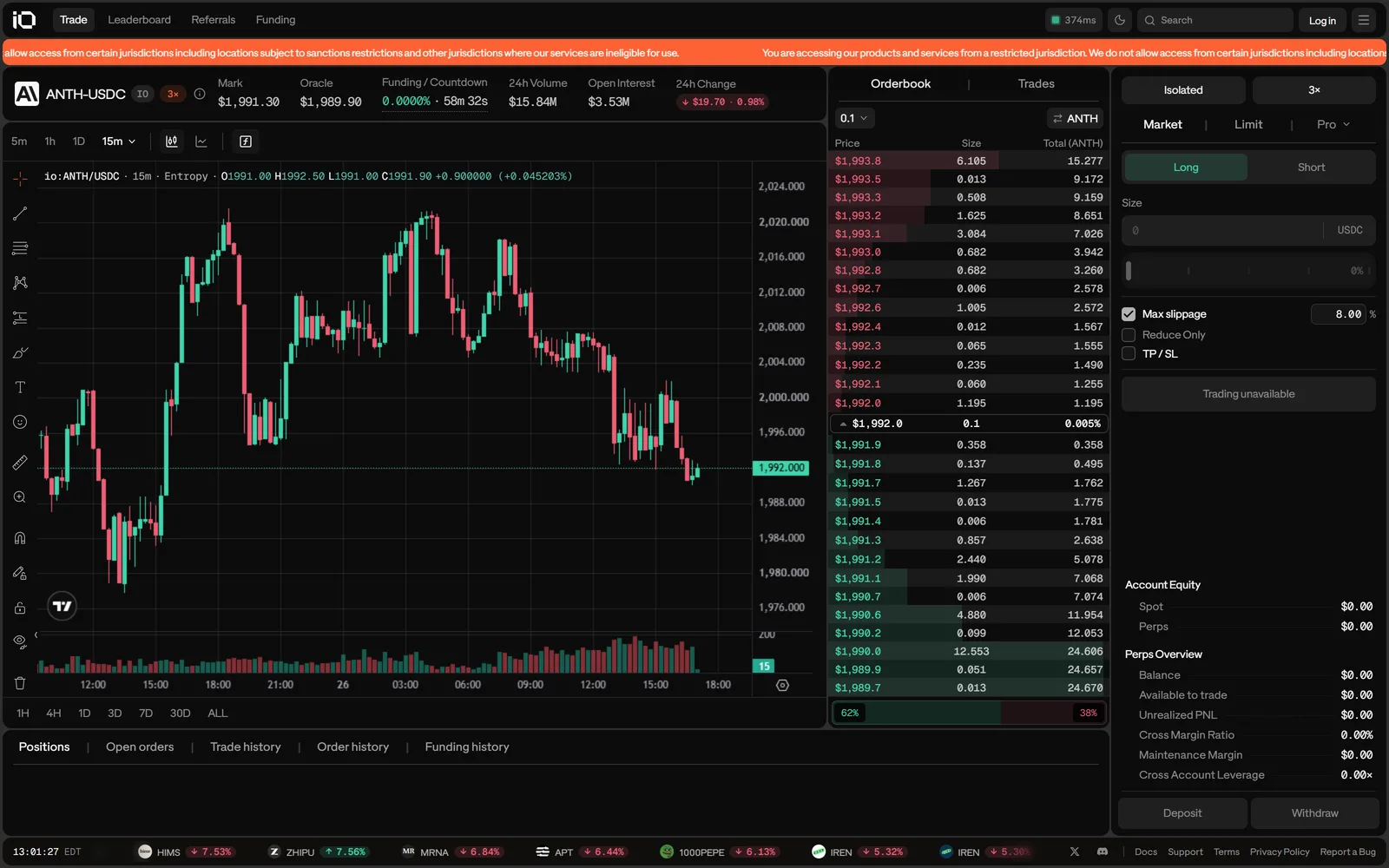
Your jurisdiction. Entropy's edge runs a geo check that returns {"restricted":true,"country":"US","mode":"trading"} from a US address. The scope is trading, not the whole site, so you can browse markets, read the order book and load charts while every trading action stays disabled. Entropy's terms of service name the United States, Canada, Panama and the United Kingdom as restricted jurisdictions, and section 2.3 prohibits VPN, proxy and Tor circumvention. We cover the full list and what the frontend actually does in Entropy restricted countries. None of that is legal advice, and if your situation is complicated, ask a professional rather than a guide site.
Your collateral. Entropy settles in USDC only, bridged from  Arbitrum One. There is no other chain, no other collateral token, and no HyperEVM route. If your USDC is anywhere else, move it first. The mechanics, the addresses and the several ways this goes wrong are in depositing USDC to Entropy.
Your key custody. Entropy authenticates through  Privy, and Privy supports both wallet sign-in and email sign-in. Email sign-in auto-creates a Privy embedded wallet. That is convenient, and it also means key management sits with Privy rather than with you. If you want the keys in your own hands, connect an existing wallet instead. Supported connectors include
 MetaMask,
 OKX,
 Coinbase Wallet, Rainbow,
 Phantom, Zerion, Uniswap Wallet and WalletConnect.
The full onboarding flow
Sign in with Privy
Open entropy.io and choose email or wallet. Wallet sign-in leaves custody where it already is. Email sign-in creates a Privy embedded wallet on your behalf, which is a real trade-off rather than a formality: you get a working account without installing anything, and in exchange a third-party provider holds the key material. Decide which you want before you fund the account, because moving later means moving funds.
Pick a username
Between 3 and 30 characters. It attaches to a public profile, shows on the leaderboard, and appears on the shareable PnL cards the app generates. You can also link an X account. If you would rather not publish your trading record, keep that in mind when you choose.
Import your HIP-3 history
Entropy scans your address for prior HIP-3 perpetual activity. This is the step most people click past, and it is the one worth reading. A single historical HIP-3 trade qualifies you for Tier 2, labeled "OG", which pays exactly double the Tier 1 rates across all three referral benefits. If you have ever touched a HIP-3 market on any deployer, including trade.xyz, Paragon or HyENA, run the import before you place your first Entropy trade.
Enter a referral code
The app reads a code from the ?r= query string and stores it in localStorage, then posts it to /api/referrals/attach when you log in. If the server returns a 400, the code is cleared silently and nothing is attached, so check the referrals page afterwards and confirm it shows as applied. Our link is entropy.io/?r=concept211, and a link with ?r= skips the marketing page and drops you straight into the terminal.
Deposit USDC
Send USDC on Arbitrum One to the Hyperliquid bridge, or use the Circle CCTP route, or the built-in fiat on-ramp. Keep about a cent of ETH on Arbitrum for gas even though you are moving USDC, and budget for Hyperliquid's one-time $1 account activation fee on your first outbound action. Full detail in the deposit guide.
Enable trading (two signatures)
This is the step that unlocks the order ticket, and it asks for two separate approvals: an agent-wallet approval and a builder-fee approval. Neither moves money. Both are covered in detail below, because the button labels do not tell you what you are agreeing to.
Place your first order
Choose io:ANTH or io:SNDK. Check whether the ticket is set to cross or isolated, and set your leverage per position. On a market order, set a max-slippage tolerance rather than accepting the default, and attach a stop-loss bracket in the same ticket instead of adding it after the fill.
Get a 25% Rebate on Every Trade
Sign up through our link and Entropy attaches its 25% referral benefit to your account automatically, paying back a share of every trade for as long as you trade. It can only be attached at signup and can never be added afterwards, so anyone who arrives without one pays the full rate permanently.
Claim Your 25% RebateWhat is the agent wallet Entropy asks you to approve?
The agent wallet is a trading key Entropy generates in your browser when you press "enable trading". You sign a Hyperliquid EIP-712 ApproveAgent message that registers it as an API agent on your account for approximately 179 days. It can open and close positions. It cannot withdraw your funds.
The key is secp256k1, wrapped with AES-GCM-256 under a non-extractable key and stored in IndexedDB under entropy-agent.
This design is standard for Hyperliquid frontends and it is what makes one-click order entry possible without a wallet popup on every trade. It also has three consequences worth stating plainly.
It is a browser artifact, so browser hygiene destroys it. Clear site data for entropy.io, use a fresh profile, or switch machines, and the key is gone. Nothing bad happens to your money, because the funds live in your Hyperliquid account and not in the agent key. You will just be asked to approve a new agent on the next visit. This is the single most common "I lost access" report in the product's own error catalog.
Anyone with the browser profile has a trading key. Not a withdrawal key, a trading key. Someone with access to that machine can open and close positions in your account for the life of the approval. Treat the device the way you would treat a logged-in exchange session.
It cannot withdraw. Withdrawals require a separate HyperliquidTransaction:Withdraw signature from the master wallet, every time. That is the meaningful boundary and it is the right one. It also means that if you sign in by email, the master wallet doing that signing is the Privy embedded wallet.
One practical limit: Hyperliquid caps how many API agents a wallet can register, at one unnamed agent plus three named ones. If you use several HIP-3 frontends from the same address, you can hit that ceiling and see an approval fail. Revoke agents you no longer use.
Our broader read on custody, controls and what is missing is in is Entropy safe. Short version: there is no 2FA, no passkey support, no withdrawal address whitelist and no hardware-wallet flow anywhere in the shipped bundle.
What is the Entropy builder fee, and what does it cost?
The builder fee is the second approval Entropy requires before your first order, and the signature authorizes a rate up to 1%. On November 24, 2026, Entropy's docs listed a frontend fee with a 0.05% base for newly created accounts, separate from exchange fees, with volume rebates of 20% to 80%. The builder address had accrued about 620 USDC in the Hyperliquid API the same day.
The table below is our August reading of the code, when the charge was zero.
Here is what the code does, stated as observation rather than interpretation.
| Item | Value, checked 26 Aug 2026 |
|---|---|
| Builder address | 0xcD254d2A328f7f67C7c6FEf930A4757516F7b601 |
| Rate configured in the shipped bundle | 0 |
| Clamp ceiling in the same code | 100 tenths of a bp, which is 0.1% |
| Rate the signature authorizes | maxFeeRate: "1%" |
| Fees accrued at the builder address | none |
| Times the word "builder" appears in Entropy's docs corpus | zero |
So: the approval you sign authorizes up to 1%, and in August the code was configured to charge 0 and nothing had been collected. Hyperliquid's protocol maximum for a perp builder fee is 0.1%, which is also the clamp in Entropy's own code, so the practical ceiling and the signed ceiling are not the same number. Because the signature sets a maximum rather than a rate, the charged rate can be changed inside that maximum without asking you to sign again.
We are not going to tell you why any of that is the way it is, because we do not know and neither does anyone else writing about it. The zero did not last: the docs now list a frontend fee, and the builder address has accrued some. Check your fill records for the rate your own account is charged. The mechanic itself, and how builder codes work across Hyperliquid, is covered in HIP-3 explained.
What can you trade on Entropy?
Entropy's screen mixes two kinds of market. Bursa Global Inc. deploys contracts under the io ticker, including io:ANTH on  Anthropic and
io:SNDK on  SanDisk. The rest belong to other deployers, such as
 trade.xyz. Referral rebates apply only to the contracts Entropy deployed itself.
On August 26, 2026 the Entropy frontend listed 319 markets in total, including 101 from trade.xyz, 19 from Paragon, 18 from HyENA, 2 from Markets by Kinetiq and 177 Hyperliquid core perps. The SpaceX, S&P 500, gold and oil markets you can reach through Entropy's interface are trade.xyz's and Kinetiq's markets, not Entropy's. Responsibility for how those contracts are specified, priced and settled sits with the deployer that registered them.
| Entropy's own markets | Underlying | Max leverage | Margin mode |
|---|---|---|---|
io:ANTH | Anthropic | 15x | Cross |
io:SNDK | SanDisk Corp. | 15x | Cross |
Check the deployer prefix before you trade a ticker more than one venue lists. For Nebius, for example, xyz:NBIS on trade.xyz is a separate contract from anything under io. The same applies to AMD on Hyperliquid, which is trade.xyz's market.
Warning
The io:ANTH price is not a share price. Anthropic listed on Nasdaq on November 19, 2026, and Entropy's docs now give io:ANTH a multiplier of 17.615 on the share price. One contract therefore moves about $17.62 for each $1 move in the stock. If you size a position thinking one contract is one share, you have misread it. See the io:ANTH guide.
Order types, flags and the ones that bite
Entropy ships a full order ticket rather than a market-buy button. The shipped types are Market, Limit, Stop Market, Stop Limit, Take Profit Market, Take Profit Limit, and TWAP.
| Type | What it does | Notes |
|---|---|---|
| Market | Fills immediately against the book | Set a max-slippage tolerance rather than leaving the default |
| Limit | Rests at your price | Pair with post-only if you want the maker rate |
| Stop Market | Triggers a market order at your stop price | Trigger is evaluated against the mark, not the last trade |
| Stop Limit | Triggers a limit order at your stop price | Can miss the fill in a fast move |
| TP Market | Take profit, filled at market | Same mark-based trigger |
| TP Limit | Take profit, resting at your price | Same miss risk as stop limit |
| TWAP | Slices a large order over a set duration | Duration must be between 5 and 1,440 minutes |
The flags are reduce-only, post-only, attached TP/SL brackets and max slippage. Three combination rules are enforced by the app and each one produces a rejection that reads like a bug if you do not know about it:
- TP/SL cannot be combined with reduce-only. Pick one.
- Write priority orders are IOC only and cannot carry an attached TP/SL bracket.
- Write priority fees are paid from undelegated staked HYPE, not from your USDC balance. If you have no undelegated stake, the order will not go through with priority.
What that fee buys (about 45 ms of latency per basis point, per Hyperliquid's docs) is also the center of a November 2026 argument over whether Hyperliquid is effectively a centralized exchange.
Because the mark price is what triggers your stop and take-profit orders, and because io:ANTH became an equity perp when Anthropic listed on November 19, 2026, the same session rules now matter on both markets. On io:SNDK the mark is anchored to SanDisk's public print during the cash session and clipped to a leverage-derived band outside it, which is why an overnight order can be rejected for going through a limit-up or limit-down band. The mechanics are covered in our guide to SNDK on Hyperliquid.
How much does it cost to trade on Entropy?
At the base tier, io:ANTH and io:SNDK cost 0.009% taker and 0.003% maker in exchange fees while growth mode is on, as it was on November 24, 2026. Entropy's docs also list a separate frontend fee, 0.05% before rebates for newly created accounts. That is on top of the exchange rate and several times larger.
The exchange rates come from HIP-3, which charges twice the standard Hyperliquid validator-operated perp rate and splits the protocol fee evenly between Hyperliquid and the deployer. That gives 0.030% maker and 0.090% taker, and growth mode scales all fees, rebates and volume contribution by 0.1.
| Base perp rate | HIP-3 (2x) | With growth mode | |
|---|---|---|---|
| Maker | 0.015% | 0.030% | 0.0030% |
| Taker | 0.045% | 0.090% | 0.0090% |
Entropy's exchange fee page now publishes the growth-mode rates. We cross-checked them in August: $66.19M of 24-hour notional at 0.009% implies $5,958 of fees, and  DefiLlama reported $5,982 for the same window. That is a ratio of 1.00, so the 0.009% exchange fee matched what traders paid.
Worth qualifying, though. Growth mode is a HIP-3 lever that every deployer has, and trade.xyz runs it too. Entropy measured 0.0091% in exchange fees in August, and that says nothing about a structural advantage. Full working in Entropy fees explained.
On top of trading fees, Hyperliquid's volume tiers and HYPE staking discounts apply on the same basis as every other Hyperliquid market, computed across your combined 14-day weighted volume.
How much is the Entropy referral rebate worth?
The entry tier returns 25% of Entropy's share of the HIP-3 fee, which works out to about 12.5% of the exchange fee you pay. It is a rebate you claim afterwards rather than a discount at the point of trade, and it covers only markets Entropy deployed, such as io:ANTH and io:SNDK.
Entropy's tiers are calculated against its share of the fee because Hyperliquid keeps the other half.
Their own worked example: on $100 of total trading fees, roughly $50 goes to Hyperliquid and $50 to Entropy, and a 50% self rebate returns 50% of Entropy's $50, which is $25.
At Tier 2, which the HIP-3 history import can hand you for one historical trade on any HIP-3 market, the rate doubles to 50% of Entropy's share, or roughly 25% of your fees. This is the single strongest argument for not clicking past the import step.
Two more things to know. The rebate applies only to Entropy-deployed markets, io:ANTH and io:SNDK, and not to the 317 aggregated markets. And rebates are claimed manually through a status ladder that runs In review, Held, Approved, Claimed, Processing, Paid. The Held state is controlled off-chain by Entropy. More detail on our referral page.
If something goes wrong on the first trade
- "Why can't I open a position?" Most often the open interest cap. The Hyperliquid API listed a $325M cap on
io:ANTHand $35M onio:SNDKon November 24, 2026. See cannot open position. - "My deposit hasn't arrived." Usually the gas trap, the activation fee, or a wallet that does not display Arbitrum One balances. See deposit not arriving.
- "Switch your wallet to chain 42161." Your wallet is on the wrong network. Arbitrum One is chain ID 42161.
- "Wallet compliance screening did not pass." Entropy runs wallet screening through a third-party provider before enabling trading.
- "My referral code was not applied." The attach call returned a 400 and the code was cleared without a visible error. Re-enter it and confirm on the referrals page.
Worth knowing before you size up
Entropy placed its first trade on 19 August 2026 and announced publicly on 24 August. It is a young venue, and we have found no published audit. There is no smart contract of Entropy's own to audit, because a HIP-3 deployer configures markets rather than deploying code, so protocol risk is inherited from Hyperliquid. The risks that are specific to Entropy are configuration risks: a single hot key can call haltTrading, which per Hyperliquid's HIP-3 documentation cancels all orders and settles positions to the current mark, and HIP-3 markets have no liquidator vault backstop, so auto-deleveraging is the immediate fallback after order-book liquidation and cannot be opted out of.
Read is Entropy safe before you put size on, and read what is Entropy if you want the entity picture. Nothing on this page is financial, legal or tax advice. See our disclaimer and our methodology for how these figures were sourced.
Fee figures on this page were checked against Entropy's documentation on November 24, 2026.
Quoting a figure? Cite this pageShow
EntropyGuides. "How to Trade on Entropy: Hyperliquid HIP-3 Setup Guide." Published August 26, 2026; last updated November 24, 2026. https://entropyguides.com/guides/getting-started/how-to-trade-on-entropy
<a href="https://entropyguides.com/guides/getting-started/how-to-trade-on-entropy">How to Trade on Entropy: Hyperliquid HIP-3 Setup Guide</a> (EntropyGuides, updated November 24, 2026)
You may republish these figures with attribution and a link to entropyguides.com/guides/getting-started/how-to-trade-on-entropy.
Frequently Asked Questions
The first is an EIP-712 ApproveAgent message that registers a browser-local trading key, valid for roughly 179 days. The second is a builder-fee approval. Both are mandatory. Neither signature moves funds, and neither grants withdrawal rights. Withdrawals require a separate signature from your master wallet every time.
The agent key lives in IndexedDB under the entropy-agent store on the device you enabled trading from. Clearing site data for entropy.io destroys it, and you will be asked to approve a new agent wallet on your next visit. Your funds are unaffected because they sit in your Hyperliquid account, not in the agent key. The reverse is also true: anyone with access to that browser profile holds a working trading key until it expires.
No. The signature authorizes a maxFeeRate of 1 percent, which is a ceiling rather than a charge. In August 2026 the configured rate was 0. On November 24, 2026 Entropy's docs listed a frontend fee with a 0.05 percent base for new accounts, separate from exchange fees, and the builder address had accrued about 620 USDC. Hyperliquid's protocol maximum for perp builder fees is 0.1 percent, and the clamp in Entropy's own code is set to that figure. This is an observation about what the code does, not a prediction about what will be charged later.
No. Entropy's geo check returns restricted true with mode trading for United States IP addresses, so the site loads and charts render but trading actions are disabled. Entropy's terms name the United States, Canada, Panama and the United Kingdom as restricted jurisdictions, and section 2.3 of those terms prohibits using a VPN, proxy or Tor to get around the restriction. This is a description of what the site does and what its terms say, not legal advice.
Market, Limit, Stop Market, Stop Limit, Take Profit Market, Take Profit Limit, and TWAP with a duration between 5 and 1,440 minutes. Reduce-only, post-only, attached take-profit and stop-loss brackets, and a max-slippage tolerance on market orders are all available as flags. Write priority orders are immediate-or-cancel only and cannot be combined with an attached bracket.
Independent resource: EntropyGuides is an independent, third-party resource operated by Concept211. It is not affiliated with, produced by, reviewed by or endorsed by Entropy, Bursa Global Inc., Hyperliquid, Hyper Foundation or Hyperliquid Labs. "Entropy", "Hyperliquid" and related names and marks belong to their respective owners and are used here only to identify the platforms this site documents. Read the full disclaimer.
Not advice: Nothing on this site is legal, tax, financial or investment advice. Descriptions of regulatory status, tax treatment and market availability are general information that varies by jurisdiction and changes over time. Confirm anything that matters to you with a qualified professional and against primary sources. Trading perpetual futures involves substantial risk of loss, and past performance does not indicate future results.
Disclosure: this site contains referral links. Signing up through our referral link applies an automatic rebate to your account and earns us a share of the fee Entropy already charges, at no extra cost to you. The rebate is quoted against Entropy's roughly 50% share of the fee, so the entry tier's headline 25% works out to about 12.5% of what you actually pay.
Get a 25% Rebate on Every Trade
Sign up through our link and Entropy attaches its 25% referral benefit to your account automatically, paying back a share of every trade for as long as you trade. It can only be attached at signup and can never be added afterwards, so anyone who arrives without one pays the full rate permanently.
Claim Your 25% Rebate