Is Hyperliquid a Centralized Exchange? A HIP-3 Trader's View
Researched and written by Concept211 from Entropy's own docs, its public API and on-chain data. Not sponsored, reviewed or approved by Entropy, Bursa Global or Hyperliquid. We earn a referral share if you sign up through our link. How we research
Table of Contents
- What the criticism says
- How Hyperliquid orders transactions, per its docs
- The base ordering inside a block
- Gossip (read) priority
- Order (write) priority
- Where that leaves the argument
- What HIP-3 changes: who runs a venue like Entropy and what they control
- What this means when you trade io:ANTH or io:SNDK
- How to judge the risk yourself
Warning
EntropyGuides is an independent, unofficial guide. We are not affiliated with Entropy, Bursa Global Inc., Hyperliquid, the Hyper Foundation or Hyperliquid Labs. Some links on this page are referral links, and we earn a share of Entropy's fee when you trade through them (see our referral page). Nothing here is financial, legal or tax advice.
Short answer:  Hyperliquid runs onchain auctions where anyone can pay HYPE to see mempool data sooner or to have certain orders processed sooner, and the fees are burned. DFINITY's founder says selling that priority makes Hyperliquid effectively a centralized exchange. Whether the label fits is a judgment call. The mechanics are public, and you can check them yourself.
- The claim: On November 15, 2026, DFINITY founder Dominic Williams said Hyperliquid is effectively a centralized exchange because it sells priority access to trading firms.
- What the docs say: Hyperliquid documents a read auction (three slots, every 3 minutes, about 20 ms each) and a write fee (about 45 ms per basis point, up to 8 bps). Any address can bid, and both fees are burned.
- What a HIP-3 deployer controls: Entropy sets the oracle, leverage, open interest caps and fees on its markets and can halt and settle them. Hyperliquid's docs give it no part in ordering transactions.
- What to check as an Entropy trader: what sets the mark price on your market, who holds the halt key, and whether your order type is the kind that faster traders can get ahead of.
If you already plan to trade  Entropy's markets, opening your account through our referral link returns 25% of Entropy's share of the fee, roughly 12.5% of what you pay, on
io:ANTH and io:SNDK. How the rebate works.
What the criticism says
DFINITY founder Dominic Williams said in a post on X that Hyperliquid is effectively a centralized exchange. The reports agree on his argument:
- TradingView News (Binance News feed), November 15, 2026, citing Odaily: Williams "said selling priority access to specific trading firms is central to the business models of many centralized exchanges," citing the New York Stock Exchange's sale of server cross-connects to hedge funds. He said onchain, open-source DEX protocols updated by a DAO do not operate this way (TradingView).
- TokenPost, November 15, 2026: Williams pointed to NYSE server connections that "can let firms trade ahead of others," and said an onchain, open-source DEX updated by a DAO "would not sell priority access" (TokenPost).
Pluang also covered the post, and its report is on pluang.com. We could not load that page on November 17, 2026, so nothing here is drawn from it.
This is one founder's opinion, posted on social media, and a rival platform's founder at that. It is not a regulatory finding or an audit. It is still worth reading closely, because the feature he describes is real and documented.
How Hyperliquid orders transactions, per its docs
Hyperliquid publishes two pieces that matter here: how actions are sorted inside a block, and the priority fee system that sits on top.
The base ordering inside a block
Hyperliquid's order book documentation states that orders match in price-time priority, and that the chain's mempool and consensus logic know which transactions touch an order book. Within each consensus batch, actions are sorted into three groups:
- Actions that do not send GTC or IOC orders to any book
- Cancels
- Actions that send at least one GTC or IOC order
"Within each category, actions are sorted in the order they were proposed by the block proposer." So cancels and other non-taking actions always go ahead of new taking orders in the same batch. That gives makers a chance to pull quotes before takers hit them.
Gossip (read) priority
The priority fees page describes "3 independent Dutch auctions synced to the same 3 minute schedule." Winners are IP addresses, and nodes that respect the auction send them mempool data in slot order. The docs put the current effect at "approximately 20 ms reduction in latency per auction slot."
Three details on that page change the picture:
- Respecting the ordering is optional for each node. The docs say nodes "optionally" interpret the auction, and that "the foundation non-validator will opt into respecting" it.
- "Any address may bid on behalf of any IP address." Each auction resets to 10 times the previous winning price, with a minimum of 0.1 HYPE, and the HYPE paid "is burned."
- Results are public. Anyone can query
{"type": "gossipPriorityAuctionStatus"}on the info API.
We ran that query at 11:30 UTC on November 17, 2026. One slot had a winning IP from the previous auction, and the other two had none. The first slot's new auction opened at about 8.96 HYPE, which under the 10x reset rule means the last winner paid about 0.9 HYPE. The other two sat at the 0.1 HYPE minimum. That is one snapshot. It changes every 3 minutes.
Order (write) priority
This is the part closest to what Williams described. Traders can attach a priority rate to an order, charged as a fraction of notional and paid out of undelegated staking balance in HYPE. It only works when every order in the action is on a non-outcome asset and every order is IOC, or every order is a non-reduce-only ALO (add-liquidity-only).
For IOC orders the docs say the effect is linear from 0 to 8 basis points, at "approximately 45 ms reduction in end-to-end latency per 1 bp." Above 8 bps, fees only break ties among orders that arrive in the same 70 ms window. And the docs still say: "Even with order priority, all cancels are prioritized before all immediately executable orders."
For ALO orders, a fee lets a newer resting order move ahead of others at the same price that were placed within the past 400 ms. It does not change how fast the order is processed. These fees are charged when the order is placed, filled or not.
Order priority fees are burned too, so validators do not collect them.
Where that leaves the argument
Both sides can point at the same page. Williams' side: speed is for sale, and in trading, a few milliseconds is an edge. The other side, which comes from the docs themselves: the auctions are open to any address, the prices and winners are public, the fees are burned rather than paid to an operator, and cancels still beat takers whatever a taker pays. The docs present the write fee as a way to reduce "the need for market makers to hyper-optimize their order entry and connectivity." Which of those matters more is up to you.
What HIP-3 changes: who runs a venue like Entropy and what they control
Entropy is a HIP-3 deployer. It runs its own markets on Hyperliquid's matching engine and margin system. HIP-3 explained covers the framework, and what Entropy is covers the company. For this question, the useful part is how the HIP-3 spec splits control between the protocol, the validators and the deployer.
Hyperliquid's HIP-3 documentation makes the deployer responsible for "market definition, including the oracle definition and contract specifications" and "market operation, including setting oracle prices, leverage limits, and settling the market if needed." The deployer must keep 500k HYPE staked, and validators can slash that stake by a stake-weighted vote for irregular inputs.
Nothing in that spec, or in the order book or priority fee pages, gives a deployer a role in ordering transactions. Ordering happens at the protocol layer, for every market at once.
| Who | What they control | Source |
|---|---|---|
| Hyperliquid protocol and block proposer | Sorting of actions inside each block (non-taking actions, then cancels, then taking orders) | Order book docs |
| Any address willing to pay | Read priority via the gossip auction; write priority via a fee on IOC or ALO orders. Fees are burned | Priority fees docs |
| Validators | Consensus, plus a stake-weighted vote to slash a deployer's 500k HYPE for irregular inputs | HIP-3 docs |
The HIP-3 deployer (Entropy for io: markets) | Market definition, oracle prices, leverage limits, open interest caps, fee share, margin modes, and haltTrading, which "cancels all orders and settles positions to the current mark price" | HIP-3 docs |
| You, the trader | Order type, leverage, margin mode, position size, and whether you pay for priority yourself | Priority fees docs |
You can see who holds each deployer permission on Entropy's io dex. Hyperliquid's perpDexs info request lists them. On November 17, 2026 it showed one address for setOracle, and a single different address for registerAsset, haltTrading, setMarginModes and setDeployerFees. We compare how other deployers split these keys in HIP-3 deployers compared.
What this means when you trade io:ANTH or io:SNDK
Entropy's own markets are 
io:ANTH (Anthropic, pre-IPO) and 
io:SNDK (SanDisk). The Williams debate concerns the protocol under both of them. The points below are what the documentation lets us say about margin, oracle and liquidation on these two markets specifically.
Priority rules apply here too. Order priority covers orders on any non-outcome asset, and HIP-3 perps are not outcome assets. On the documented rules, a trader who pays for priority on an IOC order in io:ANTH gets the same treatment as on BTC. Gossip priority covers the whole mempool stream, all markets included.
On io:ANTH, the mark comes from Entropy's own book. Entropy's mark price documentation says the mark "is the reference used for unrealized PnL, margin calculations, liquidation triggers, and stop/take-profit triggers," and that it is a "5-minute EMA of the exchange mid" that "does not blend external sources directly." The docs add that moving the mid takes capital and that the 5-minute EMA "dampens short-lived dislocations." Read alongside the priority rules, this means faster traders can get ahead of others in the book that feeds your mark. But a few milliseconds of speed moves a 5-minute average far less than it moves a single print.
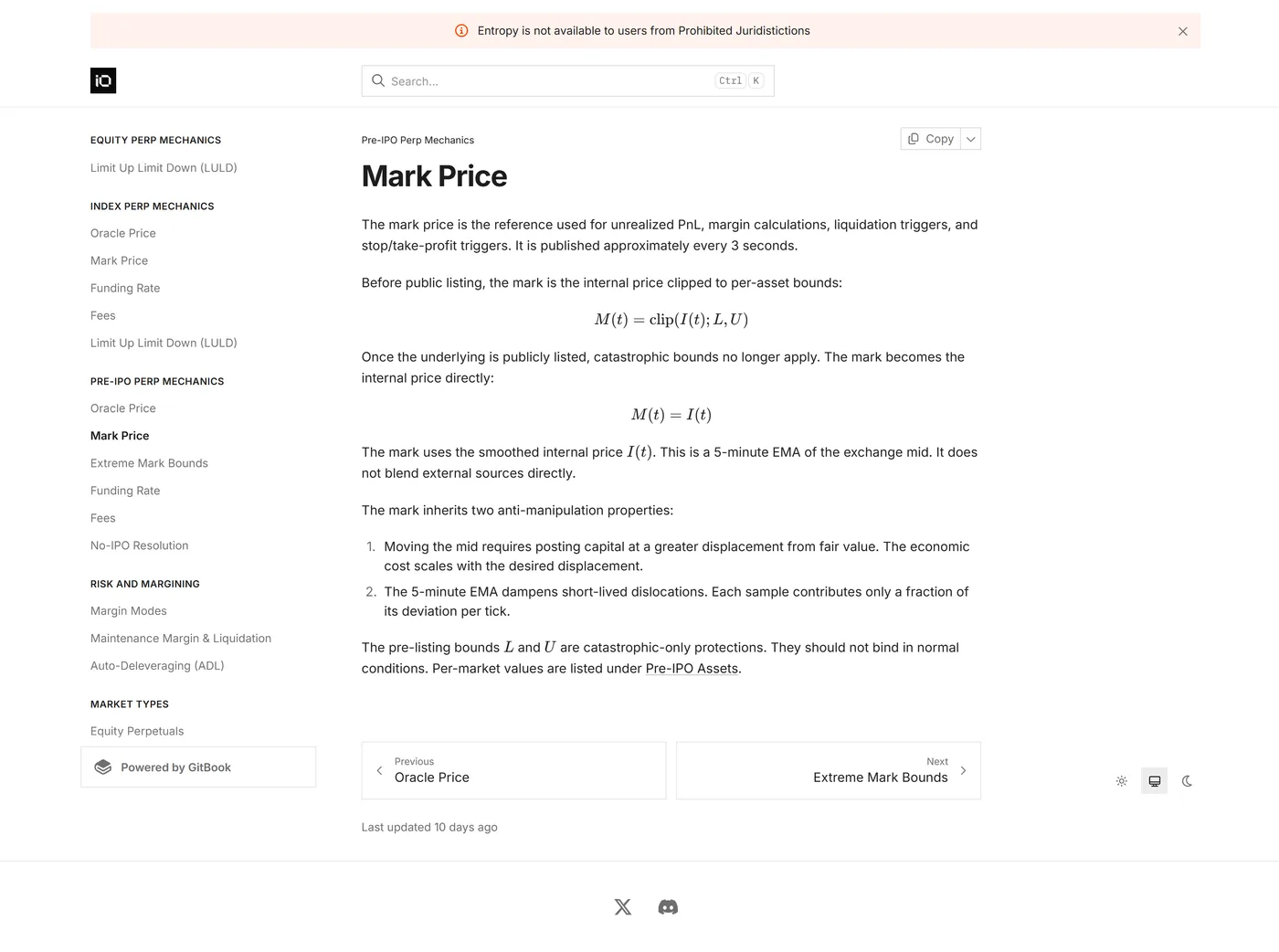
On io:SNDK, the mark blends in the stock price during market hours. Entropy's equity mark price page uses a published stock price alongside the internal price while the cash market is open. Outside those hours it falls back to the internal price within limits. Our SanDisk perp guide walks through the formula.
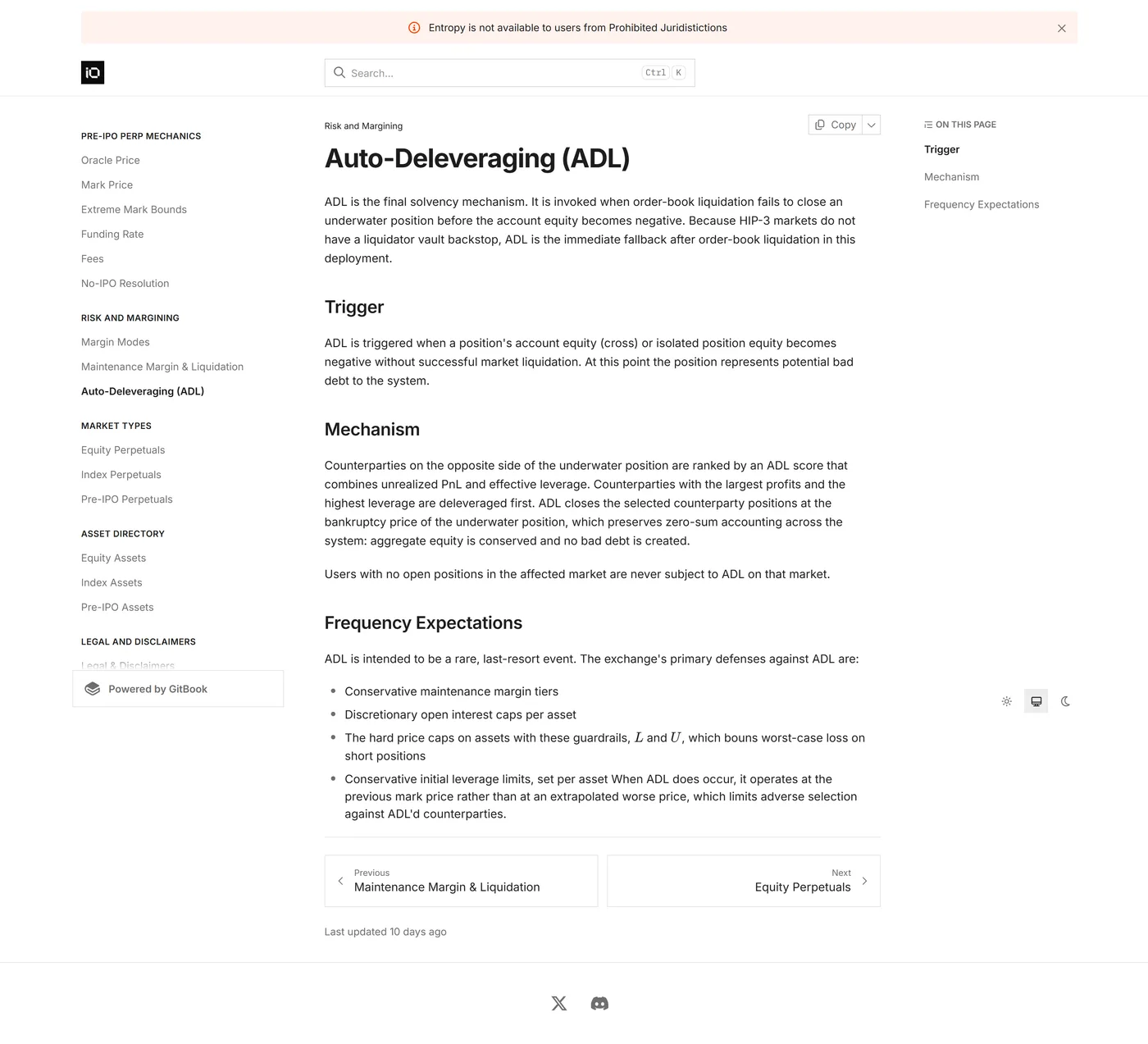
Liquidation and ADL. Entropy's ADL page says that "because HIP-3 markets do not have a liquidator vault backstop, ADL is the immediate fallback after order-book liquidation in this deployment," and lists "a io liquidator vault to be opened soon" among its planned defenses. A liquidation order is a taking order, so it competes in the same ordering as everyone else. Is Entropy safe covers the ADL chain in full.
Margin. Entropy's margin modes page says strict isolated mode is "enabled by default on new markets," meaning margin can be added to an isolated position but not removed. Check the mode on the order panel before you size a position, because it decides whether a loss can reach the rest of your account.
On these two markets, then, speed matters most for market orders taken during fast moves, against a book that also sets the mark. Whether that makes Hyperliquid "centralized" is still your call.
Get a 25% Rebate on Every Trade
Sign up through our link and Entropy attaches its 25% referral benefit to your account automatically, paying back a share of every trade for as long as you trade. It can only be attached at signup and can never be added afterwards, so anyone who arrives without one pays the full rate permanently.
Claim Your 25% RebateHow to judge the risk yourself
You do not have to take Williams' word or ours. Most of this can be checked from public endpoints and docs.
- Read the auction yourself. POST
{"type": "gossipPriorityAuctionStatus"}tohttps://api.hyperliquid.xyz/info. You get the IPs holding each slot and the live auction prices. - Know which of your orders are exposed. Paid priority applies to IOC orders and to ALO queue position. Market orders are IOC. If you rest limit orders, cancels still go ahead of every taker in the same batch, per the order book docs.
- Check what sets your mark. On
io:ANTHit is Entropy's own book. Onio:SNDKit depends on whether the stock market is open. Thin hours on a thin book are where any speed edge counts the most. - Look up the deployer keys. The
perpDexsrequest shows which address can halt trading and which sets the oracle. Then check the HIP-3 docs on what each permission can do. - Size for the bad case. ADL is the fallback after order-book liquidation on these markets, and leverage decides how close you sit to it. The how to trade on Entropy walkthrough shows where leverage and margin mode are set before you place an order.
How we source and date claims on this site is in our methodology. If a doc we quote changes, tell us and we will update this page.
Get a 25% Rebate on Every Trade
Sign up through our link and Entropy attaches its 25% referral benefit to your account automatically, paying back a share of every trade for as long as you trade. It can only be attached at signup and can never be added afterwards, so anyone who arrives without one pays the full rate permanently.
Claim Your 25% RebateQuoting a figure? Cite this pageShow
EntropyGuides. "Is Hyperliquid a Centralized Exchange? A HIP-3 Trader's View." Published November 17, 2026; last updated November 17, 2026. https://entropyguides.com/ecosystem/is-hyperliquid-centralized
<a href="https://entropyguides.com/ecosystem/is-hyperliquid-centralized">Is Hyperliquid a Centralized Exchange? A HIP-3 Trader's View</a> (EntropyGuides, updated November 17, 2026)
You may republish these figures with attribution and a link to entropyguides.com/ecosystem/is-hyperliquid-centralized.
Frequently Asked Questions
That depends on the definition you use, and this site does not rule on it. On November 15, 2026, DFINITY founder Dominic Williams said Hyperliquid is effectively a centralized exchange because it sells priority access, which he compared to the NYSE selling server connections to hedge funds. Hyperliquid's documentation describes two priority auctions, one to receive data sooner and one to have orders processed sooner. Any address can bid, and the fees are burned rather than paid to anyone.
Hyperliquid documents two kinds. Gossip, or read, priority is three Dutch auctions run every 3 minutes, and winners receive mempool data sooner, about 20 milliseconds per slot according to the docs. Order, or write, priority is a fee attached to IOC or add-liquidity-only orders, worth roughly 45 milliseconds of end-to-end latency per basis point of fee up to 8 basis points. Both fees are burned.
Hyperliquid's documentation gives a HIP-3 deployer such as Entropy no role in transaction ordering. Ordering within a block is set by the protocol's action categories and the block proposer, with priority fees applied on top. What a deployer does control is the market itself: its oracle, its leverage and open interest limits, its fees, and the haltTrading action, which cancels all orders and settles positions to the current mark price.
Hyperliquid's priority fee documentation limits order priority to orders on non-outcome assets that are all IOC or all non-reduce-only add-liquidity-only orders. HIP-3 perps such as io:ANTH and io:SNDK are not outcome assets, so on the documented rules they are eligible. Gossip priority covers the whole mempool transaction stream and is not tied to any one market.
Independent resource: EntropyGuides is an independent, third-party resource operated by Concept211. It is not affiliated with, produced by, reviewed by or endorsed by Entropy, Bursa Global Inc., Hyperliquid, Hyper Foundation or Hyperliquid Labs. "Entropy", "Hyperliquid" and related names and marks belong to their respective owners and are used here only to identify the platforms this site documents. Read the full disclaimer.
Not advice: Nothing on this site is legal, tax, financial or investment advice. Descriptions of regulatory status, tax treatment and market availability are general information that varies by jurisdiction and changes over time. Confirm anything that matters to you with a qualified professional and against primary sources. Trading perpetual futures involves substantial risk of loss, and past performance does not indicate future results.
Disclosure: this site contains referral links. Signing up through our referral link applies an automatic rebate to your account and earns us a share of the fee Entropy already charges, at no extra cost to you. The rebate is quoted against Entropy's roughly 50% share of the fee, so the entry tier's headline 25% works out to about 12.5% of what you actually pay.
Get a 25% Rebate on Every Trade
Sign up through our link and Entropy attaches its 25% referral benefit to your account automatically, paying back a share of every trade for as long as you trade. It can only be attached at signup and can never be added afterwards, so anyone who arrives without one pays the full rate permanently.
Claim Your 25% Rebate